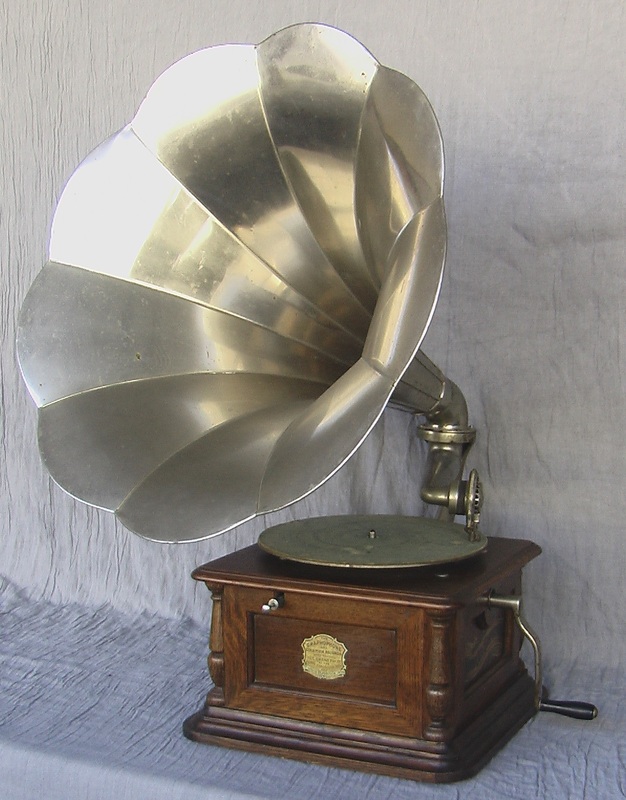
Columbia Sterling B disc phonograph
Also: disc graphophone
Contextual Associations
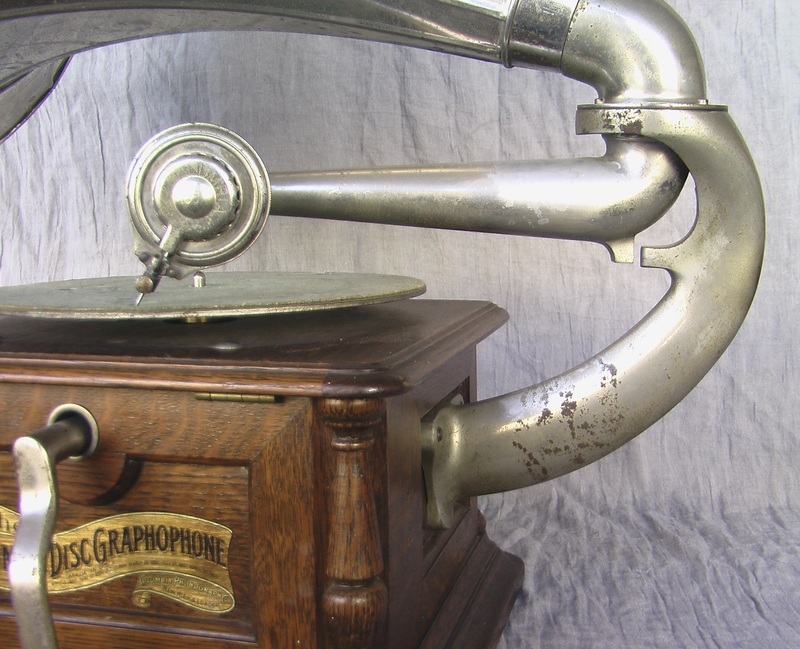
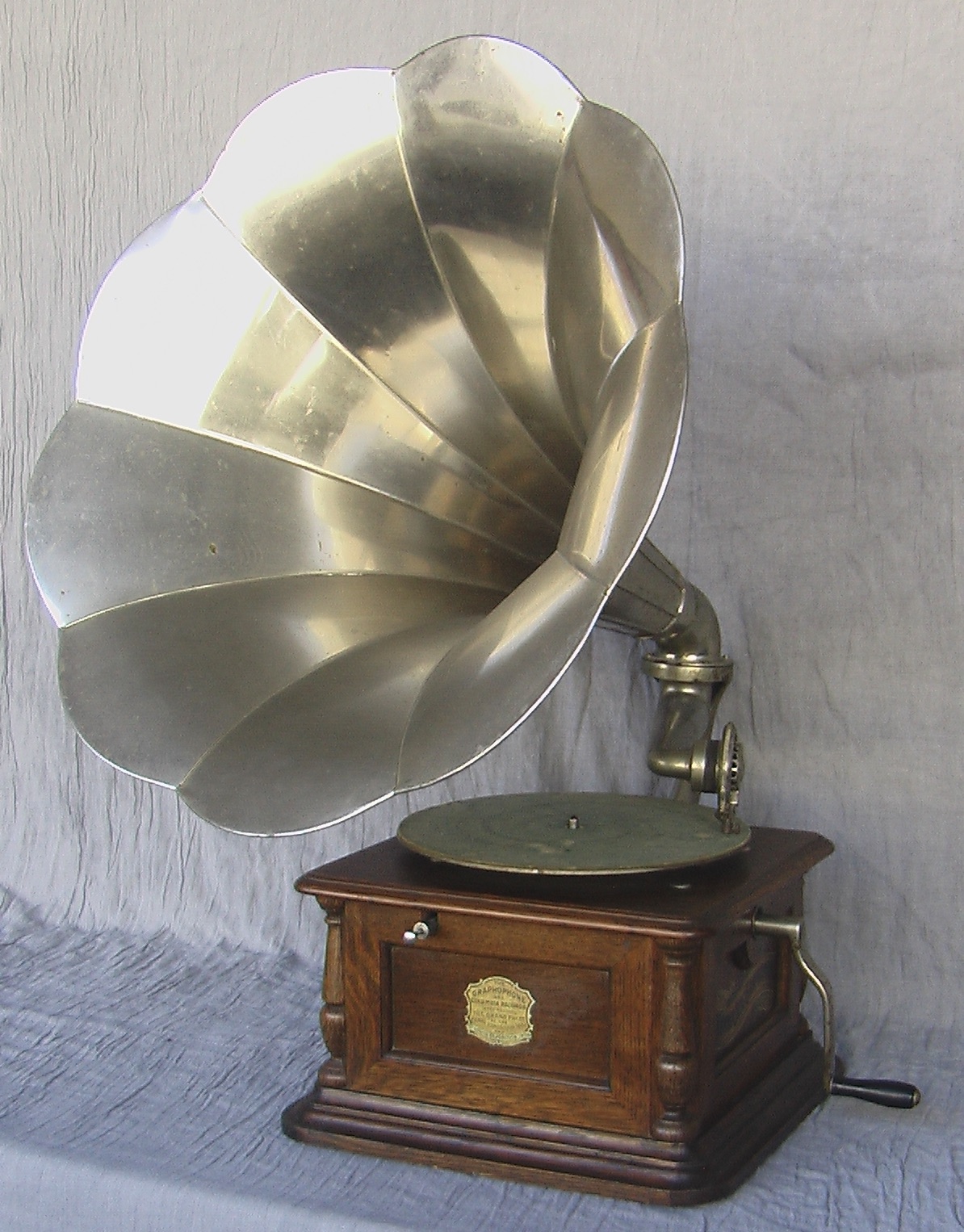
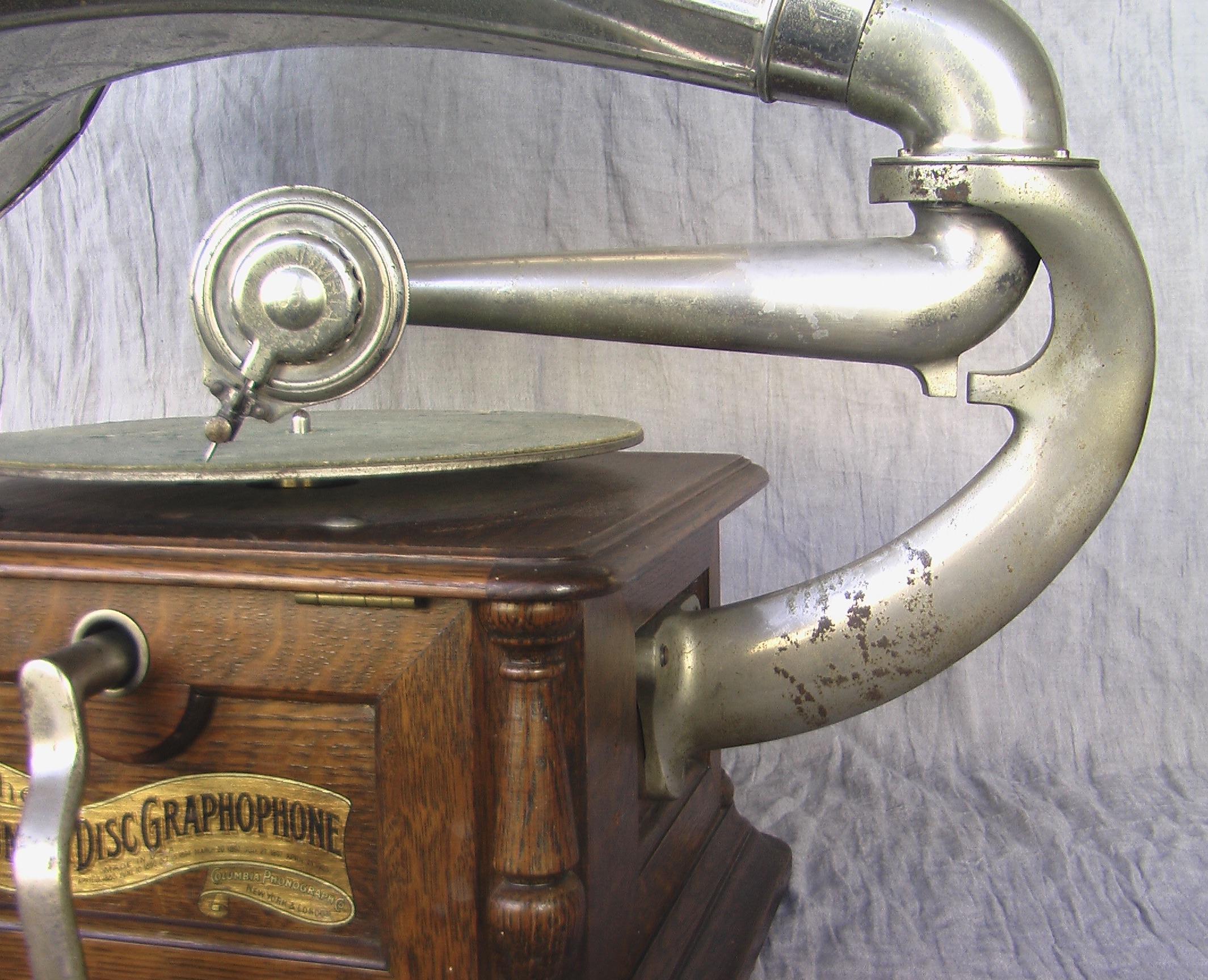
The Columbia BI Sterling disc phonograph is an external horn mechanical stylusphone idiophone designed and manufactured in the U.S.A. between 1905 or 1906-1910 and also marketed in the United Kingdom (as the Regal) and undoubtedly elsewhere on the European continent and beyond. The Sterling is capable of playing 78rpm lateral-cut disc phonograms of up to 12-inch diameter. It is a very early example of a Columbia “tone-arm” phonograph in which a reproducer is attached to the terminal end of a bracket-mounted and hollow tone-arm that then joins up to an external flaring metal horn the small end of which is connected to the same bracket (detail #3). When new in 1906, it cost $45.00. This phonograph can be seen and heard in action in the above video.
Description
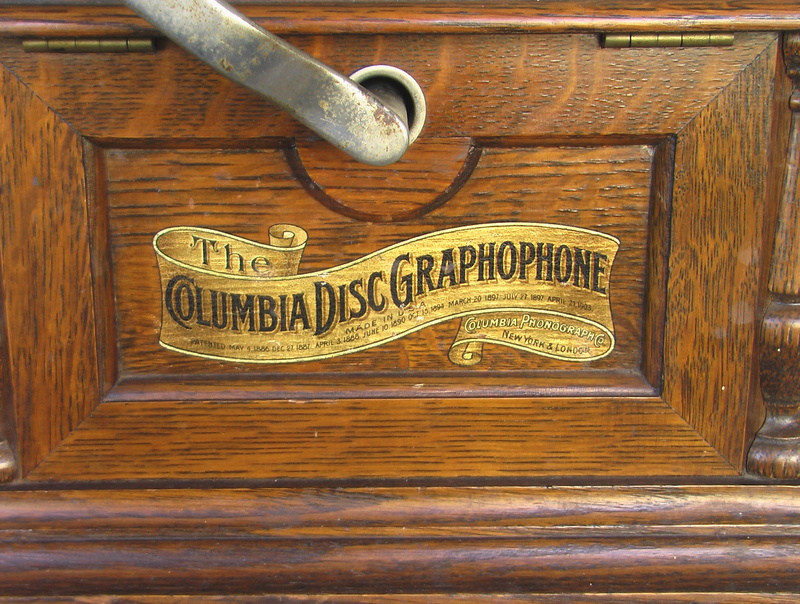
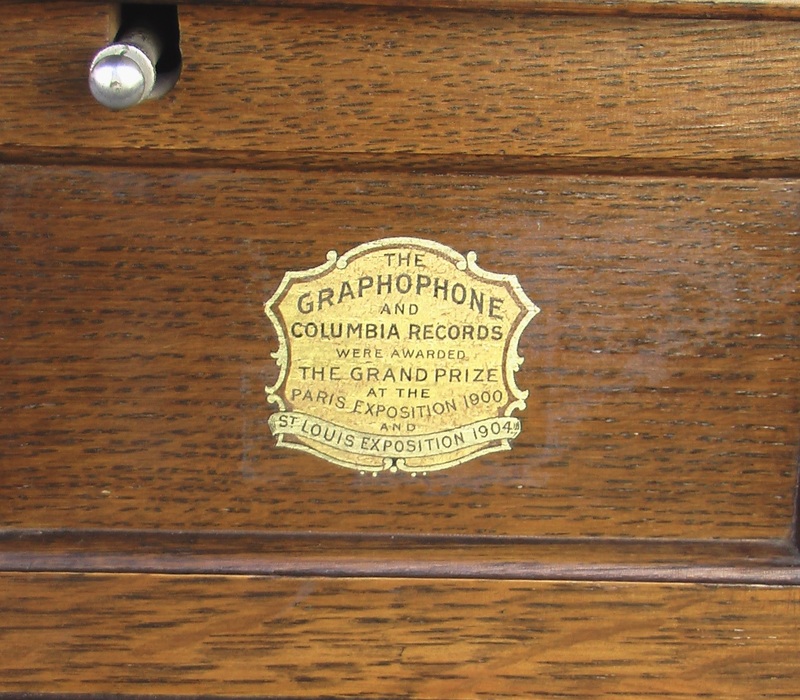
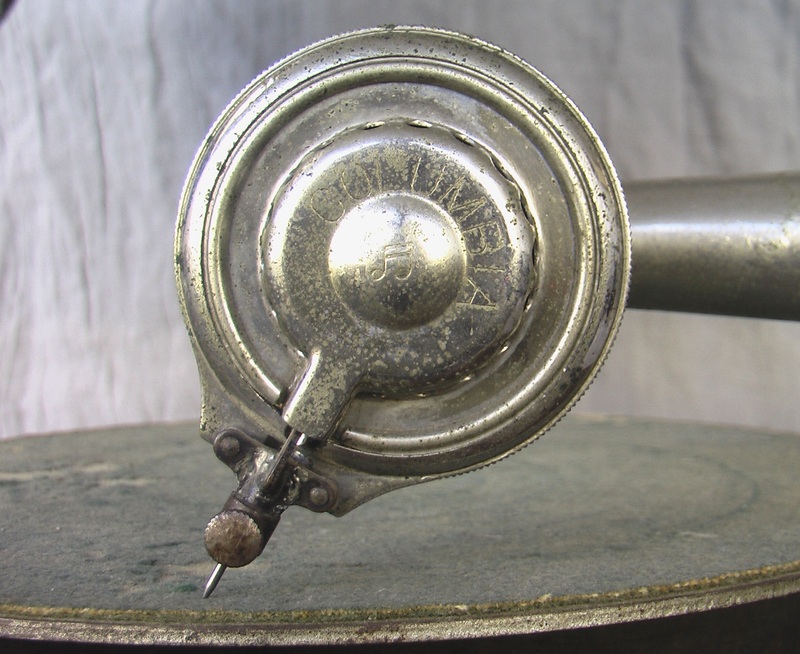
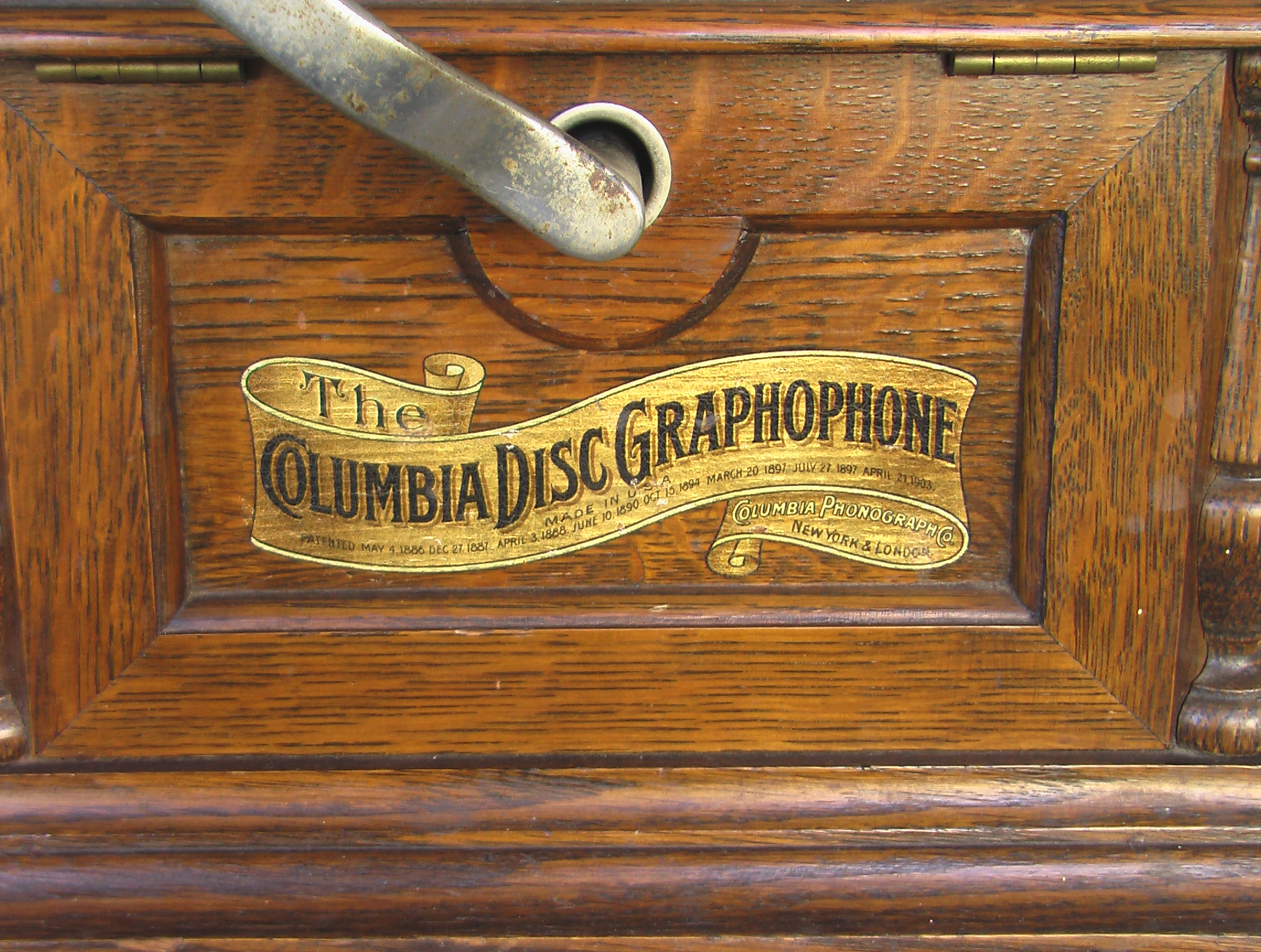
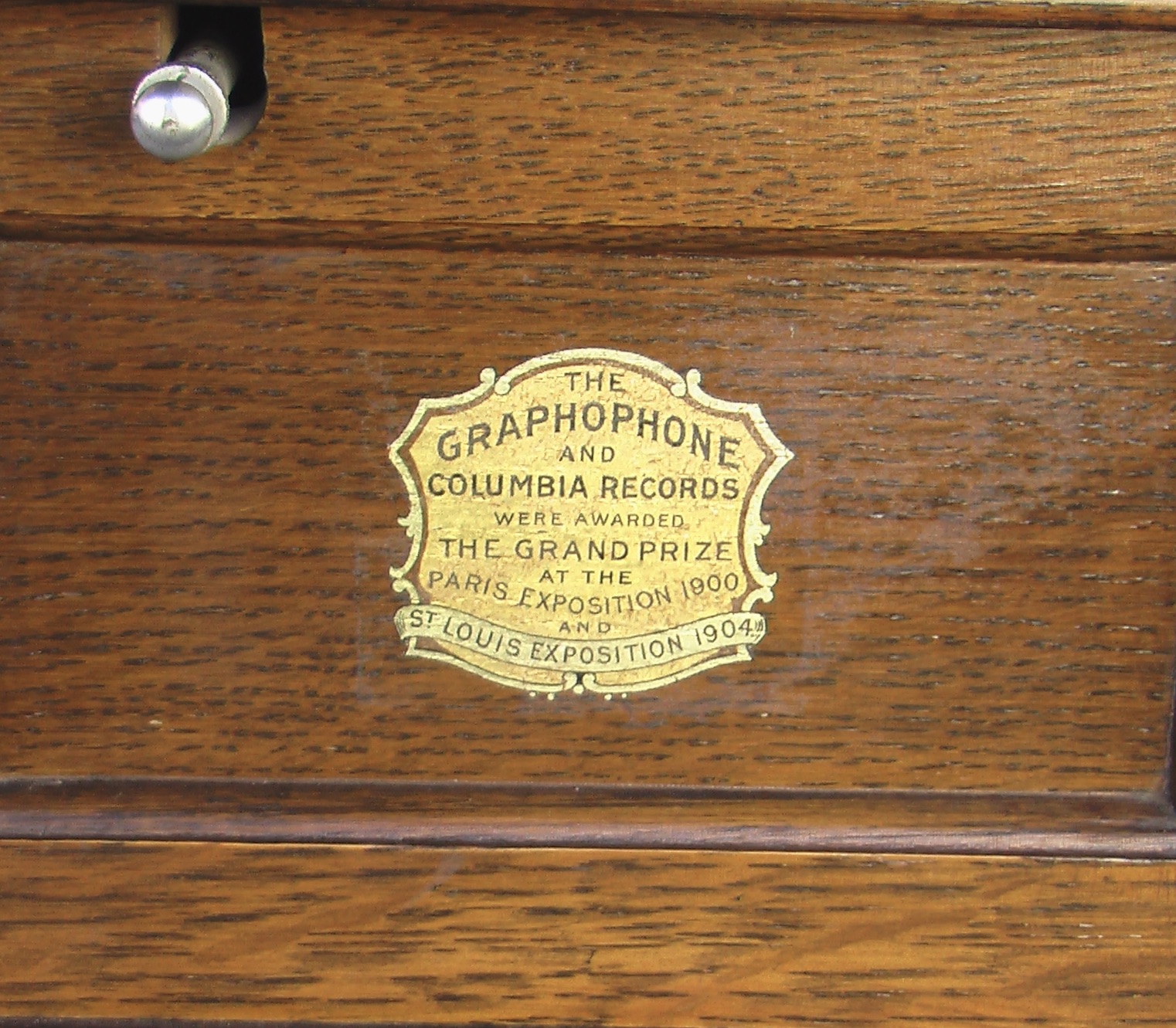
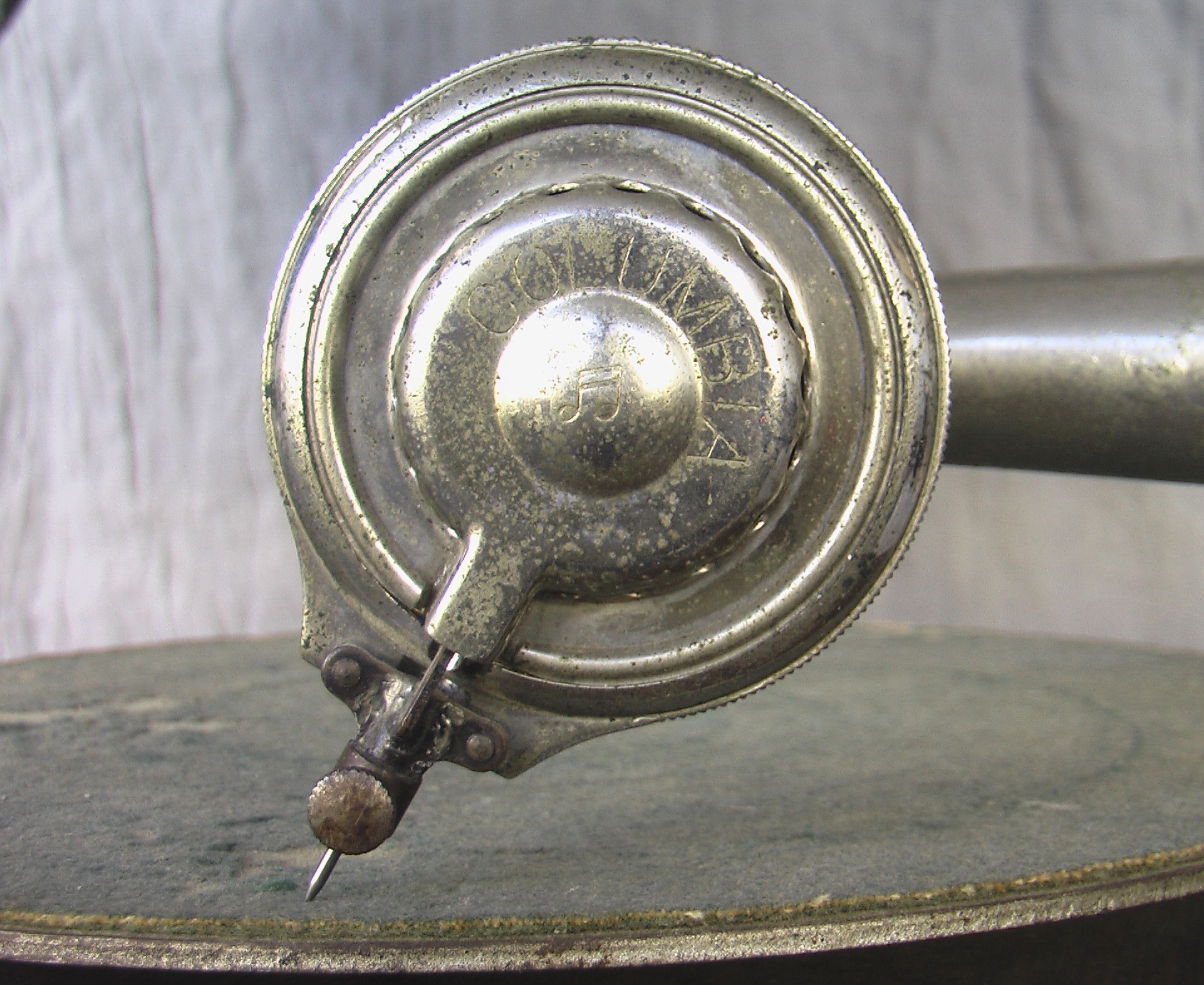
This Columbia Sterling BI has been renovated at least once in its approximately 120 years of existence. The mechanics of the machine are not easy to access, which is why there are no images or detailed description of its mechanics on this page. It is unclear if the labels attached to the case (details #1 and #2) are original or reproductions added by one of the machine’s renovators. That said, the phonograph is powered by a spring motor the (removable) crank for which fits into a hole on a side panel of the case (detail #1 and gallery images). Given that only a single 12” disc can be played when the motor is completely wound, it is most likely a single-spring motor. The tone-arm is made of aluminum and the pivoting paneled horn of nickel-plated sheet metal, the weight of both plus the reproducer are supported by the heavy metal bracket mounted to the backside of the instrument’s wooden case (detail #3). The earliest model of the Sterling had a metal dust ring underneath the circumference of its turntable; the Sterling BI pictured here neither has such a dust ring nor shows signs of ever having one, which means it is a later model. A sharp needle needs to be attached to the reproducer using the built-in screw mount (detail #4) and needs to be replaced after being used for the playing of a few phonogram sides.
Player - Instrument Interface and Sound Production
The player of the Sterling graphophone needs to make sure a sharp metal stylus is attached to the reproducer and that the phonograph motor is completely wound. A 78rpm disc of any diameter up to 12 inches is then placed on the felt-covered metal turntable so that the tip of the motor’s spindle protrudes through the hole at the middle of the disc. The user then releases the on-off brake by pulling out on the small knob on the front face of the cabinet (upper left corner of detail #2) and gently places the reproducer needle at the beginning of the phonogram’s groove spiral. When the recorded material encoded on the disc ends, the user must lift up the needle/reproducer/tone arm and swing it back beyond the edge of the phonogram and then push the brake knob in to stop the rotation of the turntable. The phonogram can then be safely lifted off the turntable.
Origins/History/Evolution
While sound capture was first invented by Thomas Edison in 1878, Emile Berliner invented the disc-shaped phonogram and the disc phonograph (called, at first, a “gramophone”) in the early 1890s. By the end of the first decade of the 20th century, the disc phonograph (or gramophone, talking machine, disc graphophone—pseudonyms for the term “phonograph” the copyright for which was owned by Edison and used for his products) truly began to dominate the fast-evolving record industry and continued to do so until the advent of the digital compact disc (CD) in the 1980s. Columbia started out making cylinder graphophones in the late 1890s but began to transition to disc graphophones around 1902; during the rest of the first decade of the 20th century, Columbia phased out their production of cylinders and cylinder players until completely abandoning them by 1910. Purely mechanical, non-electric phonographs started to give way to electrified phonographs and recording processes in the early 1920s. By the end of that decade, spring-motor phonographs and acoustical recording processes were totally eclipsed by electricity-powered phonographs with styluses that converted acoustical signals to electrical signals that were amplified by amplifiers and heard through loudspeakers, and the electrification of the recording studio and the mastering of recorded performances.
Bibliographic Citations
Fabrizio, Timothy C., and George F. Paul. 1997. The Talking Machine: an illustrated compendium, 1877-1929. Atglen, Pennsylvania: Schiffer Publishing Ltd.
Reiss, Eric L. 2003. The Compleat Talking Machine. 4th ed. Chandler, AZ: Sonoran Publishing, LLC.
Instrument Information
Origins
Continent: Americas
Region: North America
Nation: U.S.A.
Formation: Euro-American
Classification (Sachs-Von Hornbostel revised by MIMO)
112.511.1
Design and Playing Features
Category: idiophone
Energy input motion by performer: none
Basic form of sonorous object/s for idiophone: needle/stylus
Sound objects per instrument: one
Resonator design: separate horn-shaped resonating space – attached to exterior of instrument
Number of players: one
Sounding principle: flexing - indirect
Sound exciting agent: contours on the sides of a phonogram groove
Energy input motion by performer: none
Pitch of sound produced: definite pitch
Sound modification: none
Dimensions
13.0 in. width of case
13.0 in. depth of case
7.6 in. height of case
2.6 in. diameter of soundbox
10.0 in. diameter of turntable
30.0 in. height of phonograph (including horn)
21.0 in. diameter of horn
19.0 in. approximate depth of horn
Primary Materials
wood
metal
sheet metal
felt
Maker
Columbia
Model
c.1906, Sterling B
Entry Author
Roger Vetter