Roxy portable disc phonograph
Also: suitcase phonograph Roxy
Contextual Associations
This Roxy portable disc phonograph is a mechanical stylusphone idiophone with an internal horn designed and manufactured probably in the U.S.A. in the 1920s. It is an off-brand machine--the actual manufacturer of the Roxy is not known and there is no known Roxy phonograph company. Rather, this machine was most likely made by an independent manufacturing company that would customize its products to the wishes of its customers who themselves were businesses such as department or furniture stores. While some phonograph manufacturers started producing portable disc record players in the 1910s, the 1920s was the decade in which the development of portable machines really took off. The Roxy is an excellent example of 1920s phonograph design innovation emphasizing portability; machines such as the Roxy are sometimes referred to as “suitcase” phonographs. The Roxy is capable of playing 78rpm discs of any diameter up to 12 inches. This phonograph can be seen and heard in action in the above video.
Description
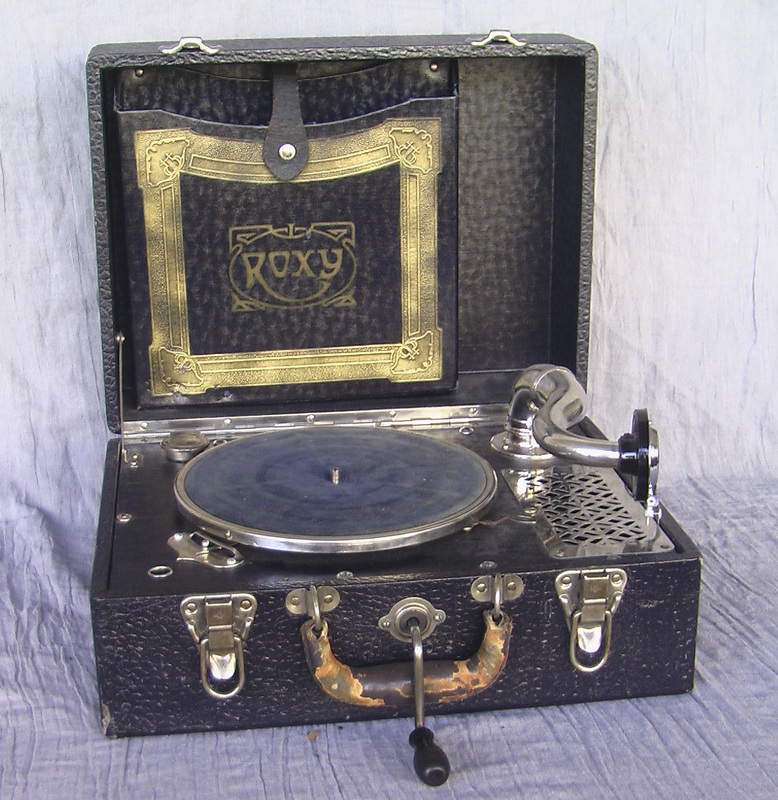
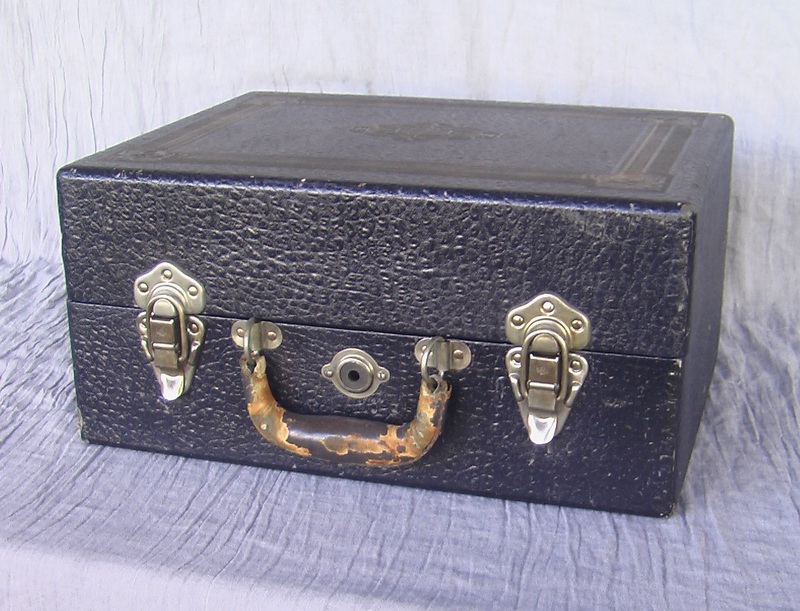
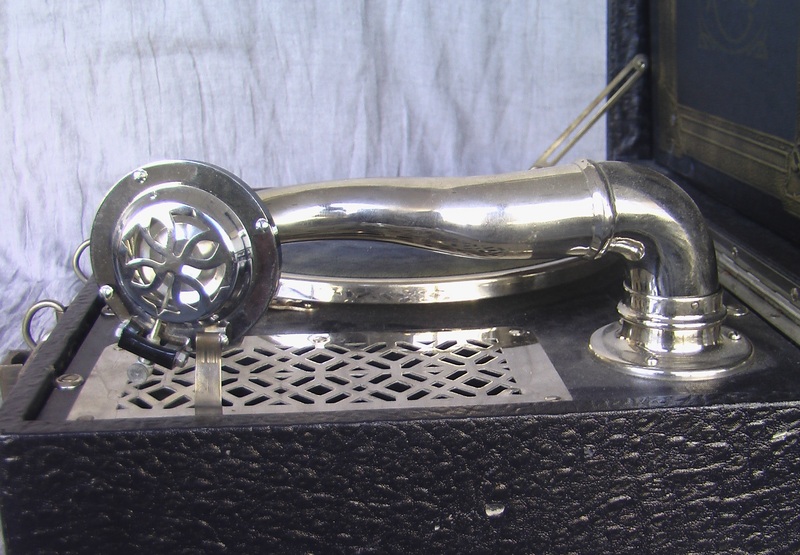
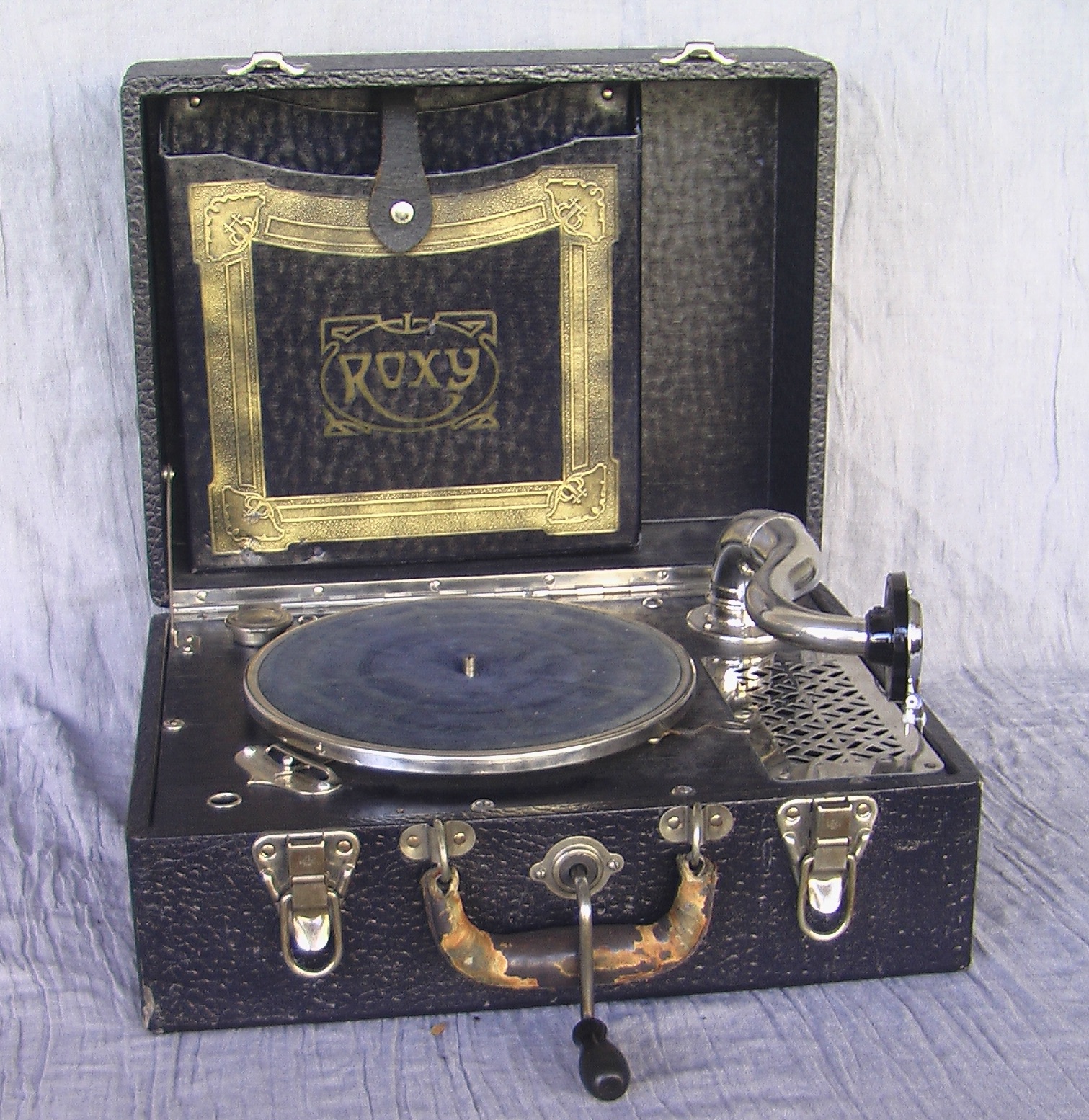
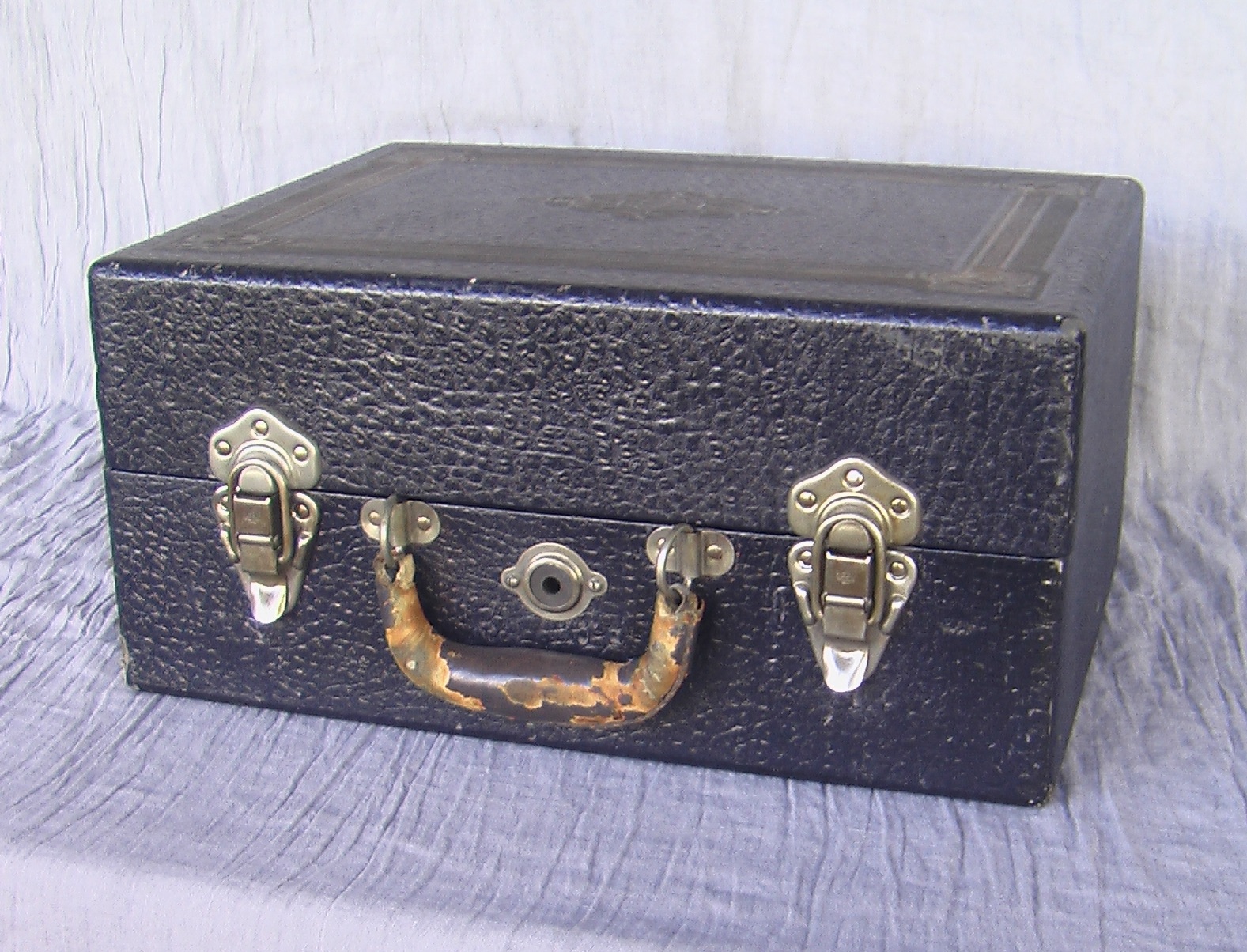
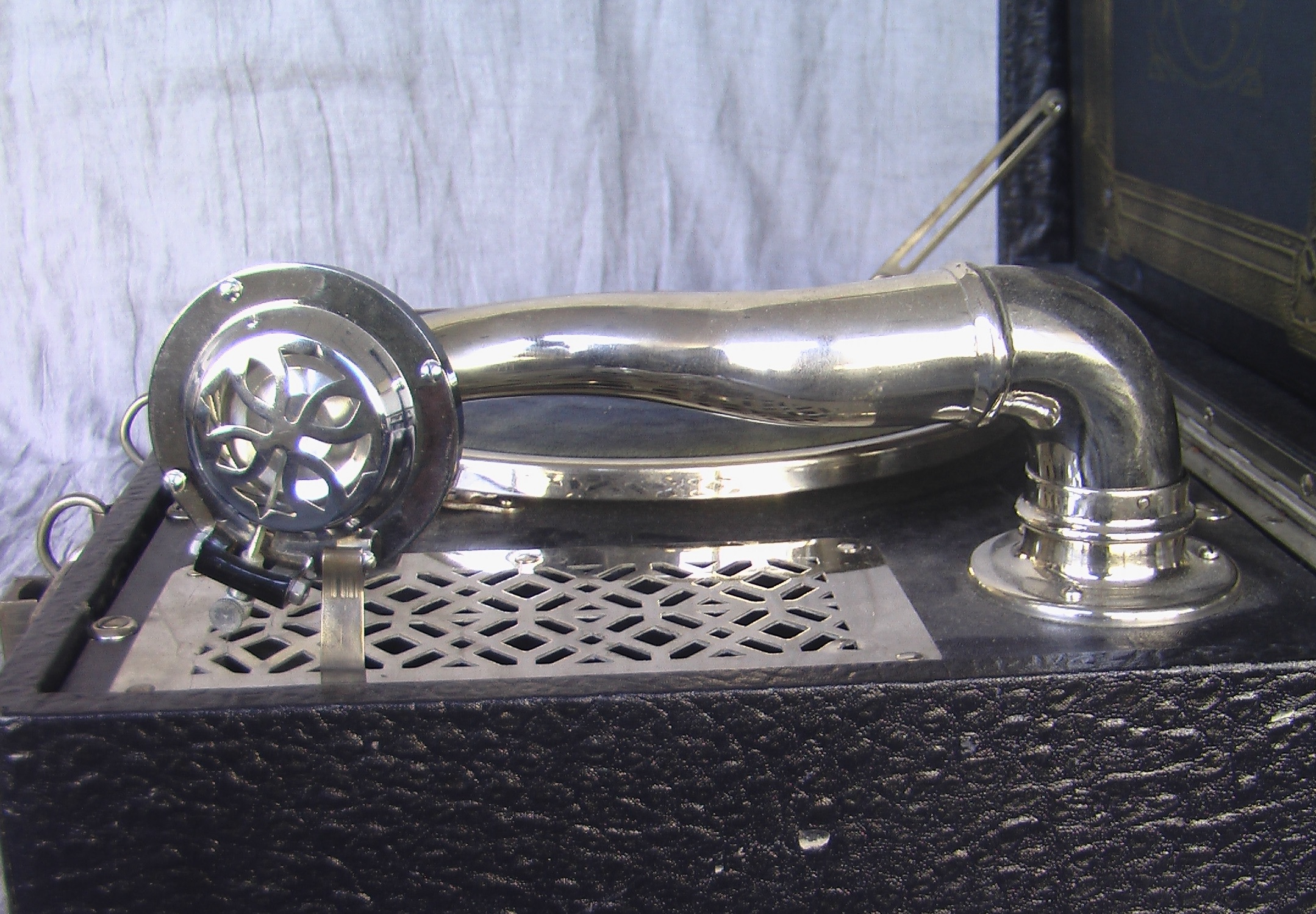
The Roxy has all the same basic components of a larger cabinet phonograph of the time compactly enclosed into an inexpensive wooden box with a lid hinged at the top of one of its shorter side boards and covered with a tough artificial leather material called Fabrikoid (a Dupont product) (gallery #1 and #2). Inside the box case (and out of sight) is a single-spring motor made by some unknown manufacturer. The motor is wound with a removable crank the shaft of which is located on the front sidewall of the case (gallery #1). When not in use, the crank can be removed and stored inside the case. The top face of the 9-inch metal turntable is covered with felt; the operation of the turntable is controlled with two brakes: 1) an on-off switch brake is operated with a lever that is located beneath and to the right of the turntable; and 2) a speed-control brake that is operated with a sliding lever on the top inside board of the phonograph, allowing the operator to fine-tune the rotation of the turntable within the range of 70rpm to 90 rpm (gallery #1). The metal tonearm (possibly of brass with a nickel covering) has a soundbox at one end while its other end is attached to a pivoting mount that is permanently attached over a hole in the top board of the interior box (detail #1). Beneath this hole is a Fabrikoid-lined resonator space the top of which is partially covered with a metal grill. It is through this grill (see detail #1) that the sound of the reproducer diaphram (possibly made of aluminum) is heard. The top board of the inner box also includes a small, lidded needle box (see gallery #1) and the interior of the phonograph’s lid includes a simple record holder with the word “Roxy” engraved in its Fabrikoid covering (gallery #1). When the lid is closed, the entire phonograph can be carried like a small suitcase by using the handle attached to the outside front face of the case (gallery #2).
Player - Instrument Interface and Sound Production
To play a 78rpm disc on the Roxy phonograph the user must first place the machine on a flat surface and then open the lid by releasing the lid clips and fully opening the lid (gallery #1). If a sharp-pointed metal needle is not already attached to the reproduced, that can be done at this point. The non-handle end of the motor hand crank can then be inserted into the hole on the front-side of the machine and turned clockwise until met with resistance and then rotated as many times as necessary to fully wind up the motor spring. After placing a phonogram (a 78rpm disc) on the turntable, the motor brake can be released by sliding the on/off switch lever to the left, which sets the turntable and phonogram into rotation. The user than lowers the reproducer needle onto the phonogram; if the rate of rotation needs adjustment, this can be accomplished by sliding the speed-control lever while the phonogram is being played.
Origins/History/Evolution
While sound capture was first invented by Thomas Edison in 1878, Emile Berliner invented the disc-shaped phonogram and the disc phonograph in the early 1890s. By the end of the first decade of the 20th century, the disc phonograph (or gramophone, talking machine, disc graphophone—pseudonyms for “phonograph”) truly began to dominate the fast-evolving record industry and continued to do so until the advent of the digital compact disc (CD) in the 1980s. Purely mechanical, non-electric phonographs started to give way to electrified phonographs and recording processes in the early 1920s. By the end of that decade, spring-motor phonographs (such as the Roxy) and acoustical recording processes were totally eclipsed by electricity-powered phonographs with styluses that converted acoustical signals to electrical signals that were amplified by amplifiers and heard through loudspeakers, and the electrification of the recording studio and the mastering of recorded performances.
Bibliographic Citations
Victrola Collector. n.d. “Roxy portable phonograph 1920s.” YouTube video accessed Jan. 10, 2026: https://www.youtube.com/watch?v=u3tHMi8yXGA
Instrument Information
Origins
Continent: Americas
Region: North America
Nation: U.S.A.
Formation: Euro-American
Classification (Sachs-Von Hornbostel revised by MIMO)
112.511.2
Design and Playing Features
Category: idiophone
Energy input motion by performer: none
Basic form of sonorous object/s for idiophone: needle/stylus
Sound objects per instrument: one
Resonator design: separate horn-shaped resonating space - built into instrument
Number of players: one
Sounding principle: flexing - indirect
Sound exciting agent: contours on the sides of a phonogram groove
Energy input motion by performer: none
Pitch of sound produced: definite pitch
Sound modification: none
Dimensions
15.4 in. width of case
12.0 in. depth of case
7.3 in. height of case (closed)
16 in. height of case (open)
2.5 in. diameter of soundbox
Primary Materials
wood
Fabrikoid
metal
felt
Maker
unknown
Model
1920s
Entry Author
Roger Vetter