Contextual Associations
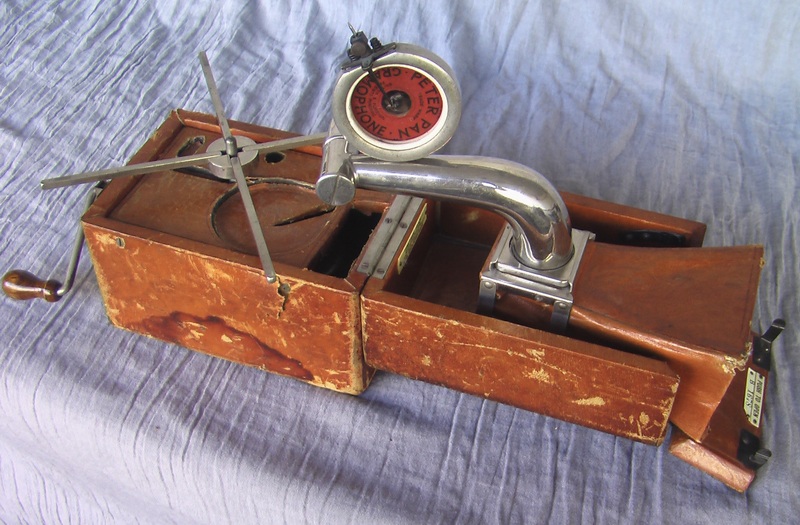
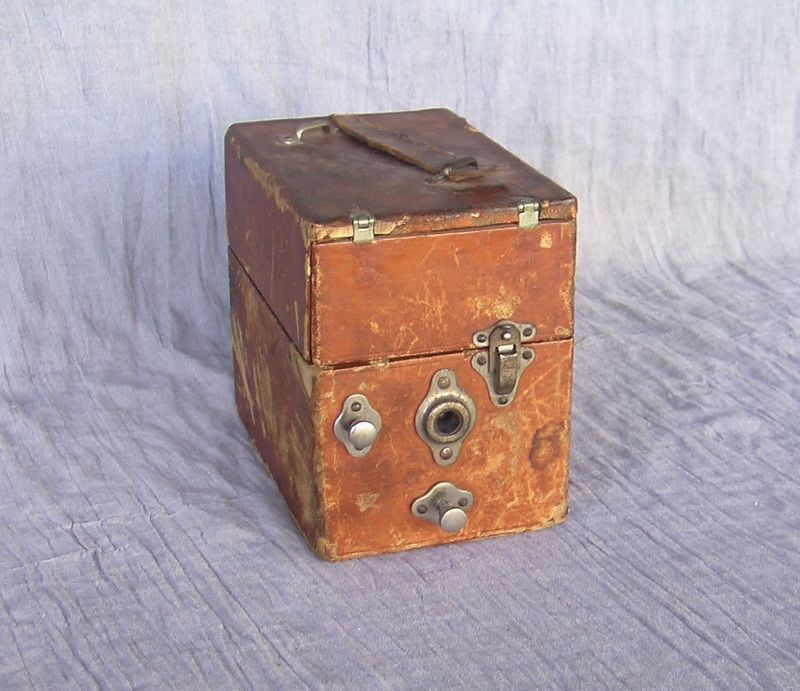
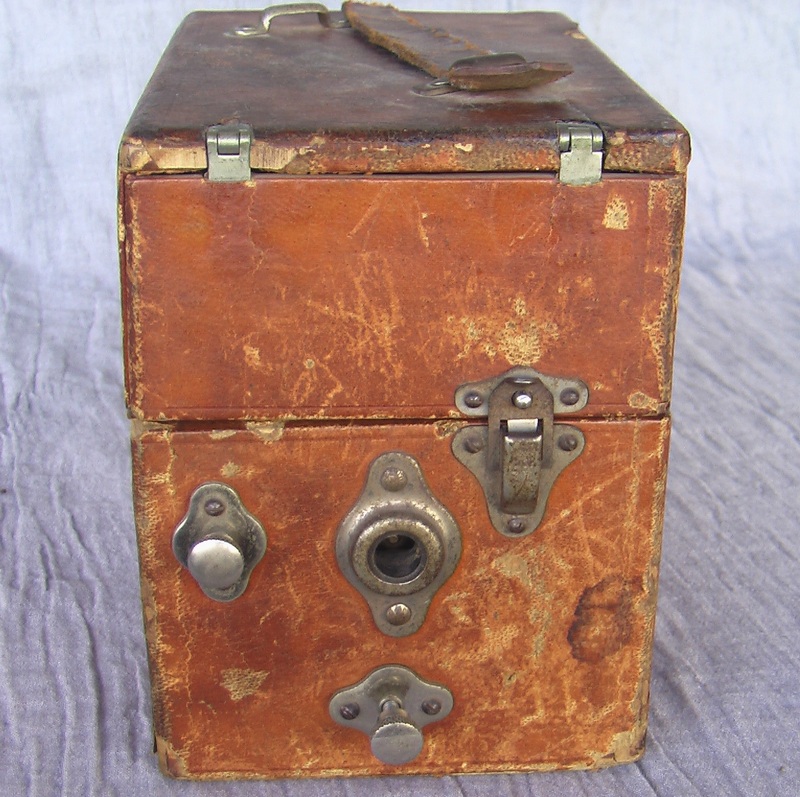
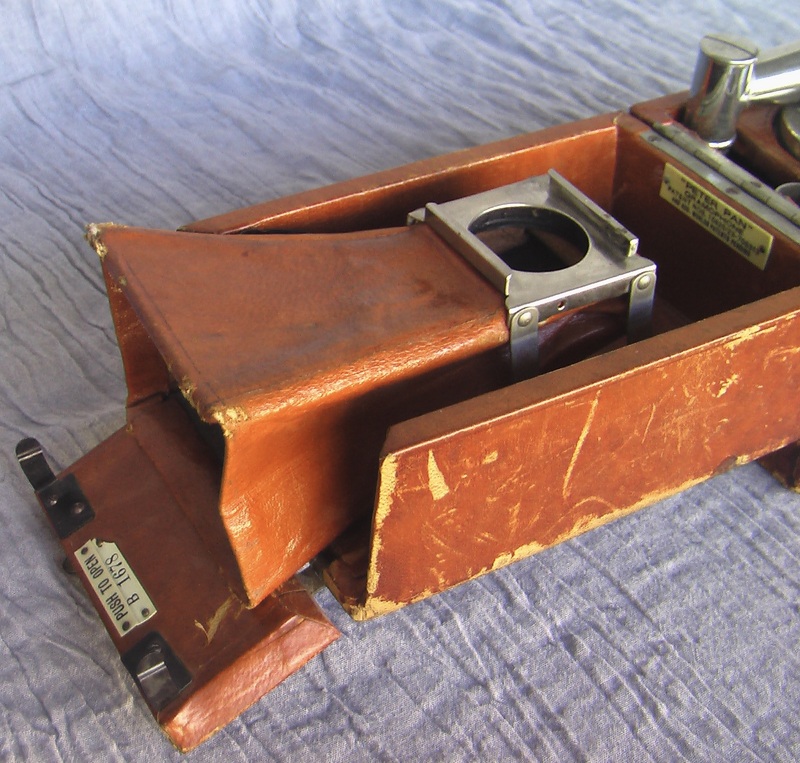
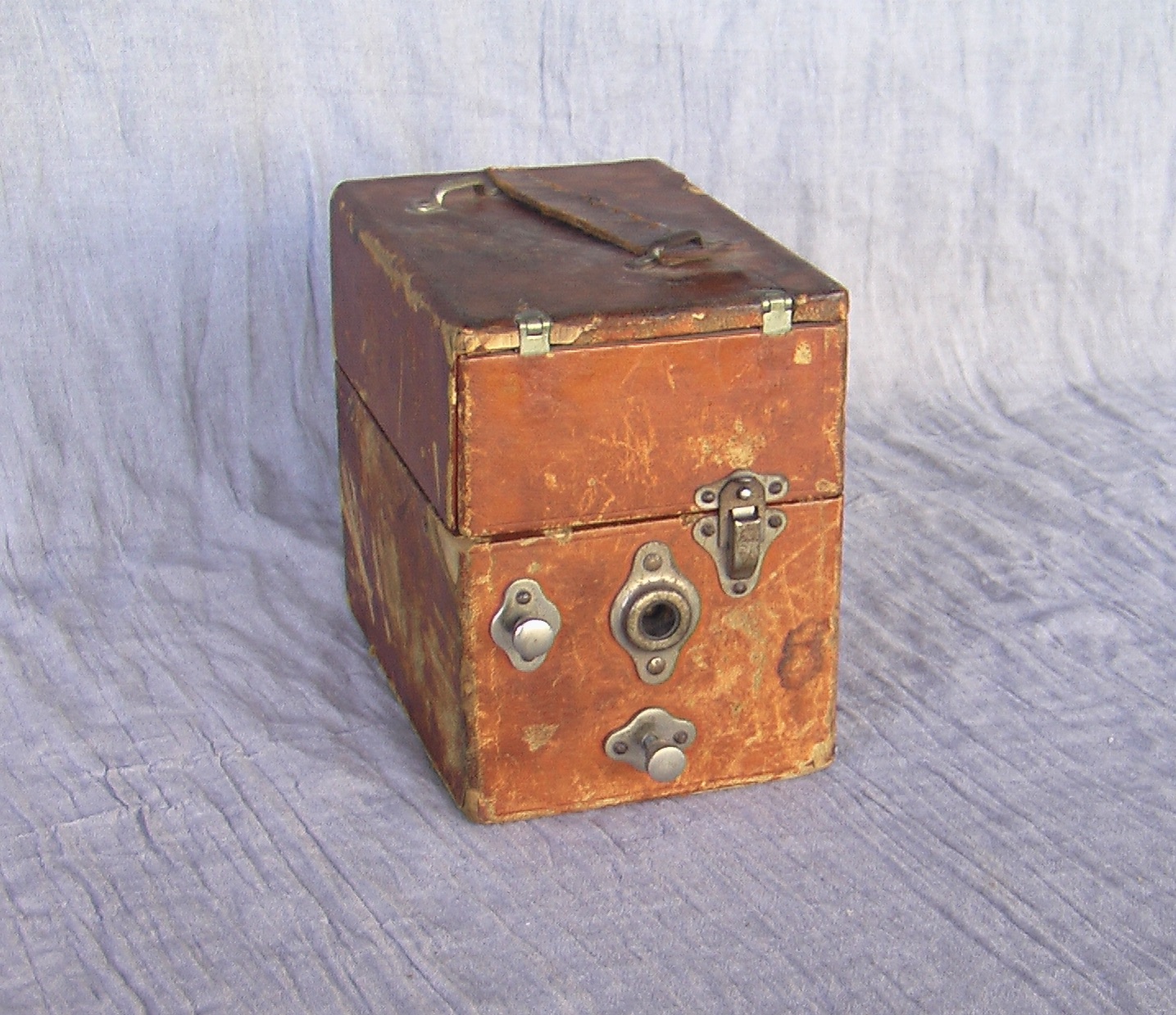
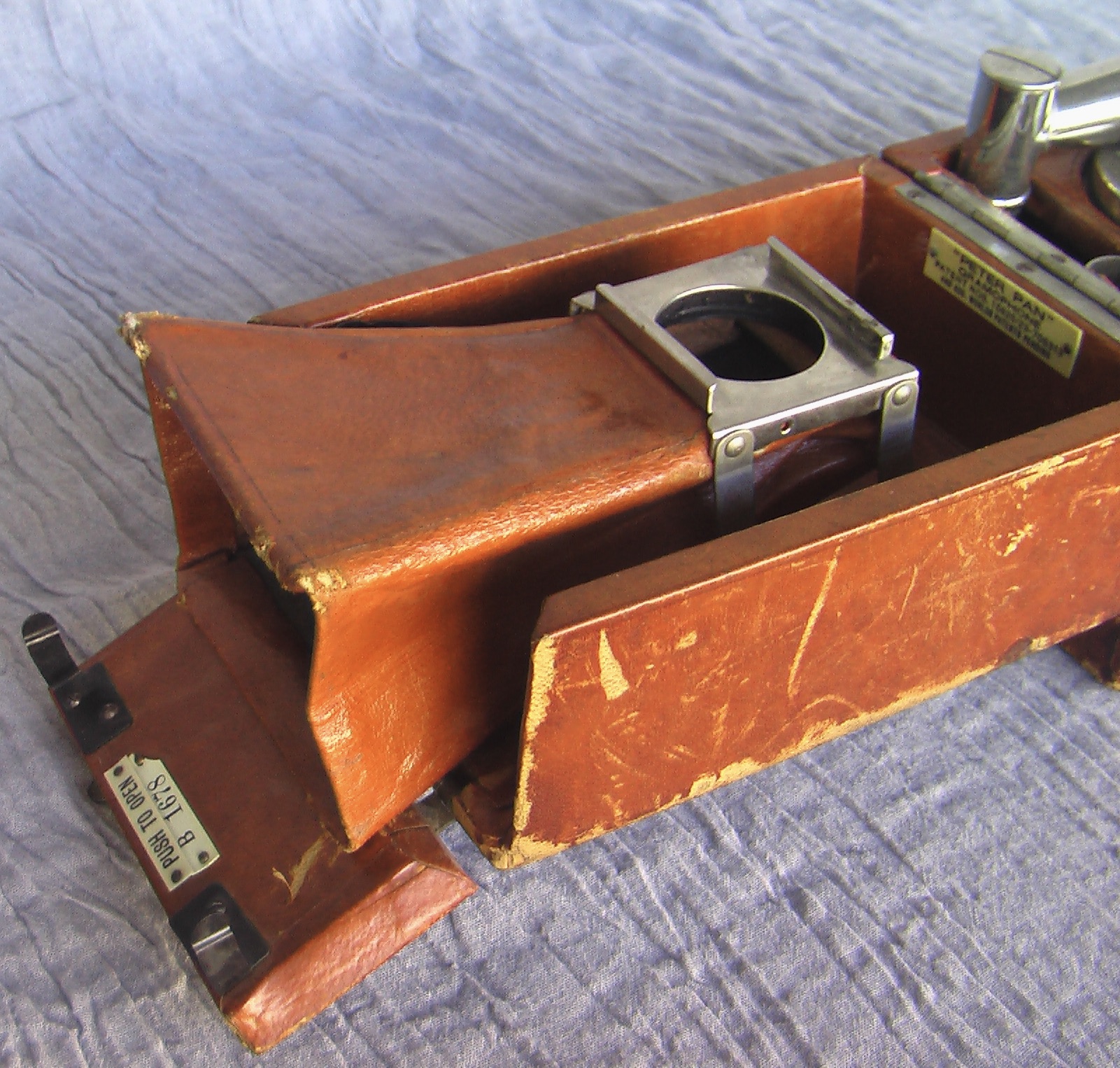
This Peter Pan portable disc phonograph is a mechanical stylusphone idiophone designed and manufactured in England in the early 1920s but eventually distributed globally. While some phonograph manufacturers started producing portable disc record players in the 1910s, the 1920s was the decade in which the development of portable machines really took off. The Peter Pan Gramophone, first sold in 1923 (with design changes added to subsequent models), is an excellent example of 1920s phonograph design innovation emphasizing miniaturization and portability. Inside a cube visually reminiscent of the contemporary Kodak Brownie camera (much the rage in the 1920s) (gallery #2), phonographs such as the Peter Pan where often referred to as “camera phonographs” or “cameraphones.” The Peter Pan Gramophone found in the Grinnell College Collection was probably made and first sold in the mid-1920s; it differs from the original design of this phonograph most obviously in it having a folding leather horn incorporated into the interior of its lid, whereas the original model had a telescoping conical metal horn attached to the backside of its soundbox. All models of the Peter Pan are capable of playing a 78rpm disc of any diameter up to 12 inches. The Peter Pan Gramophone Company Limited ceased operation in 1929. [Much of the information in the above paragraph and on this page was gleaned from an excellent website article written by Callan Bird and Deeksha Bhardwaj and published by the Museum of Transport and Technology in Aukland, New Zealand. An image of a later-model Peter Pan (an alarm clock version, perhaps from 1929), is found on page 243 of Fabrizio and Paul (1997).]
Description
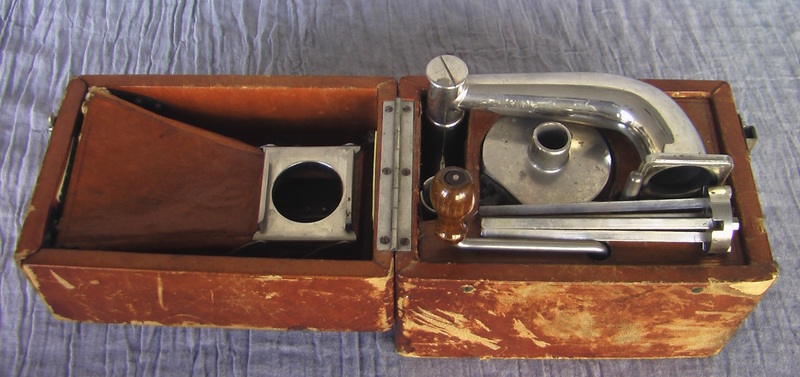
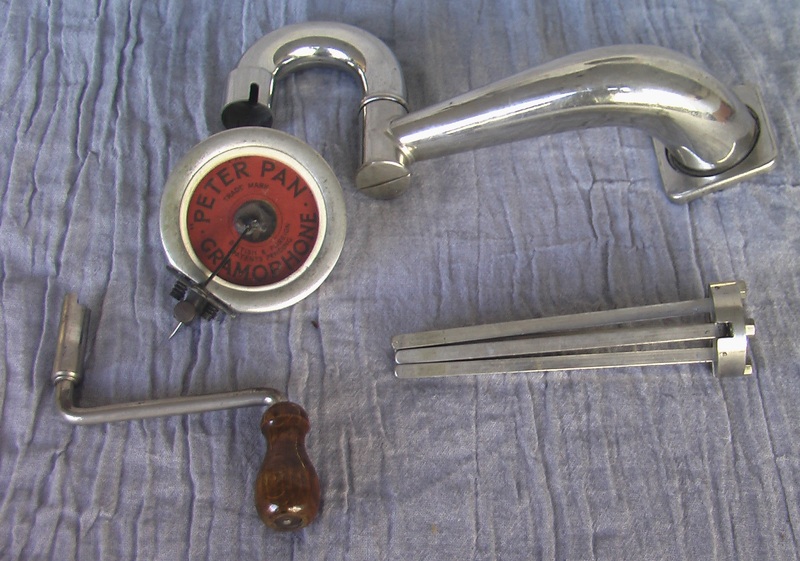
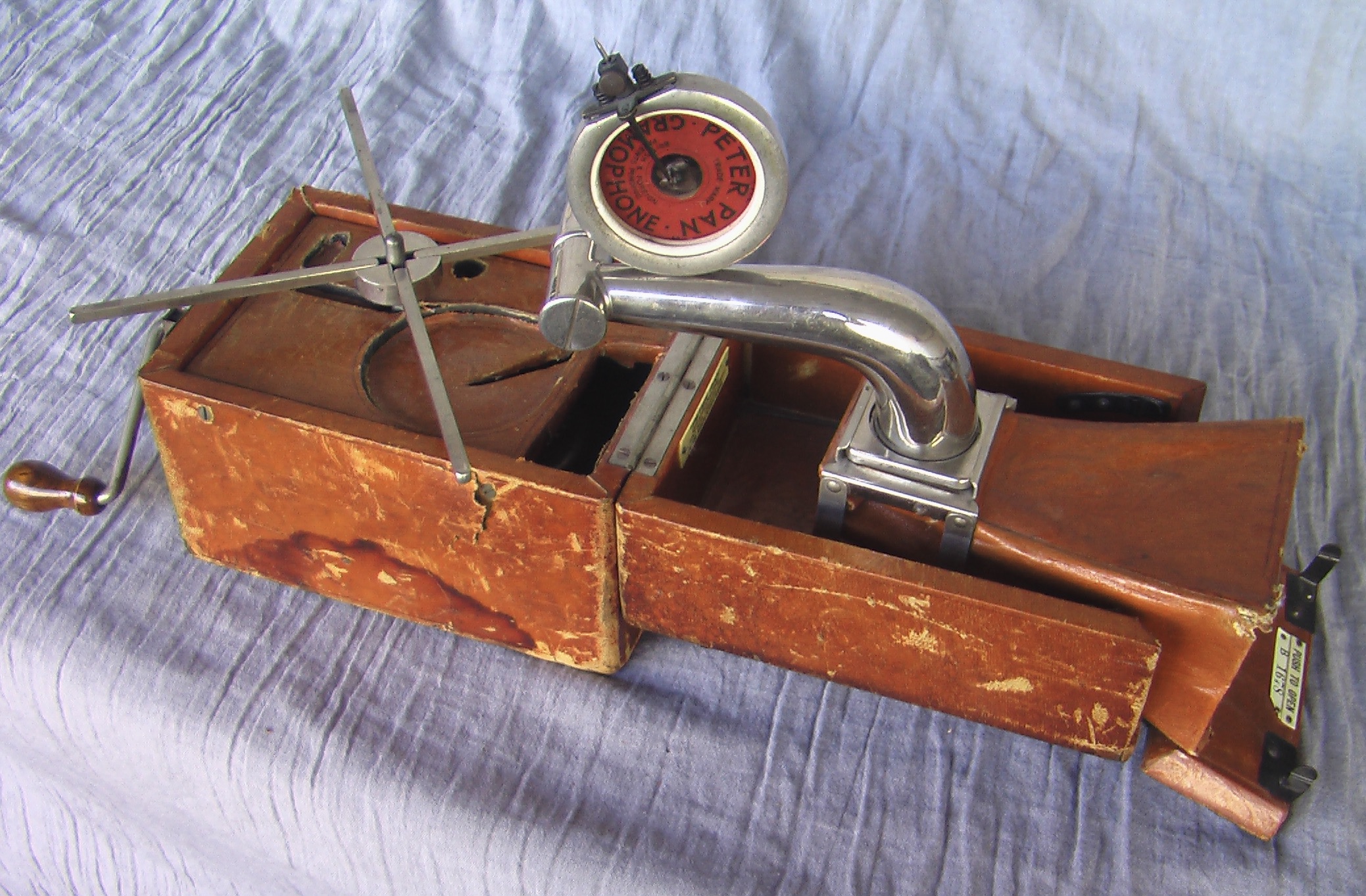
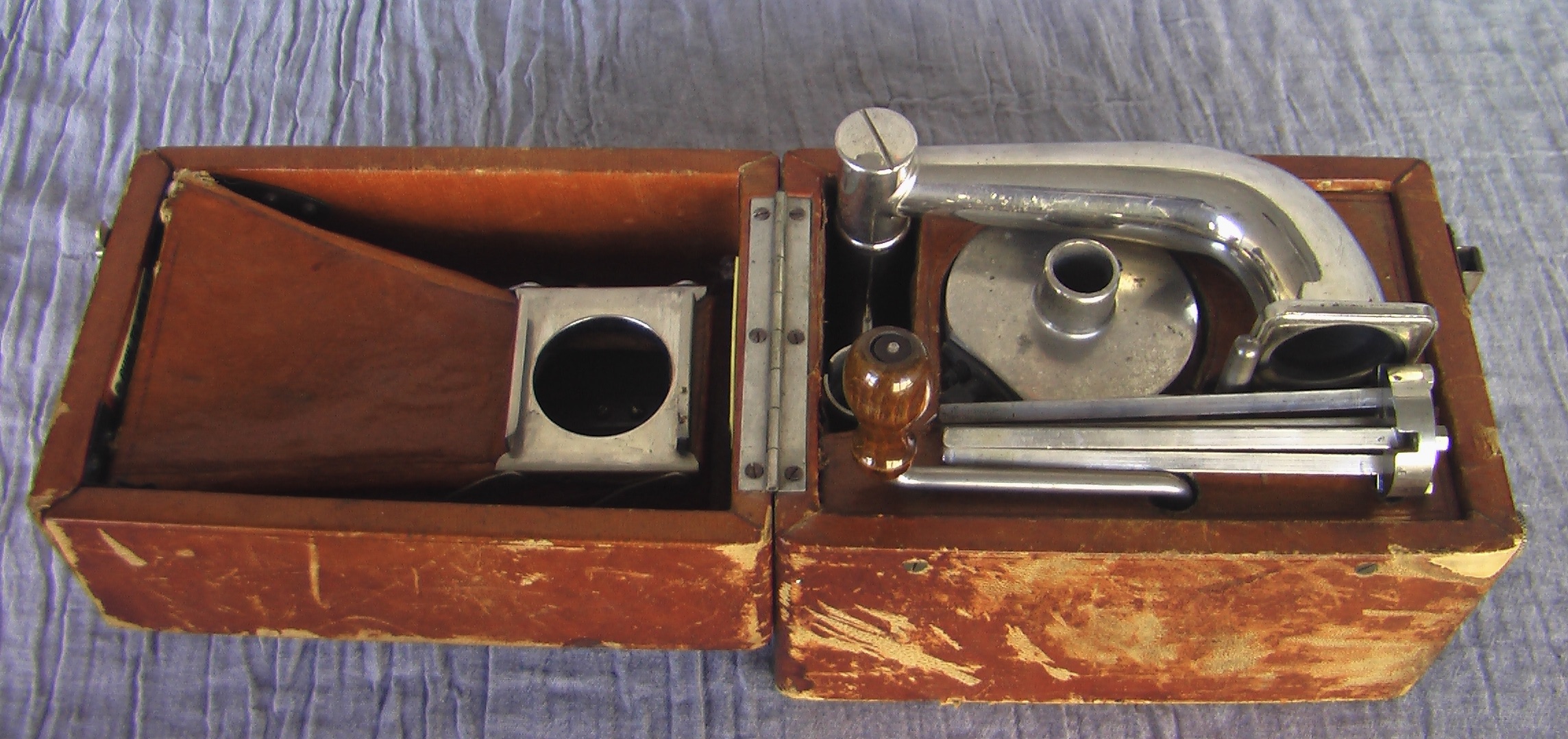
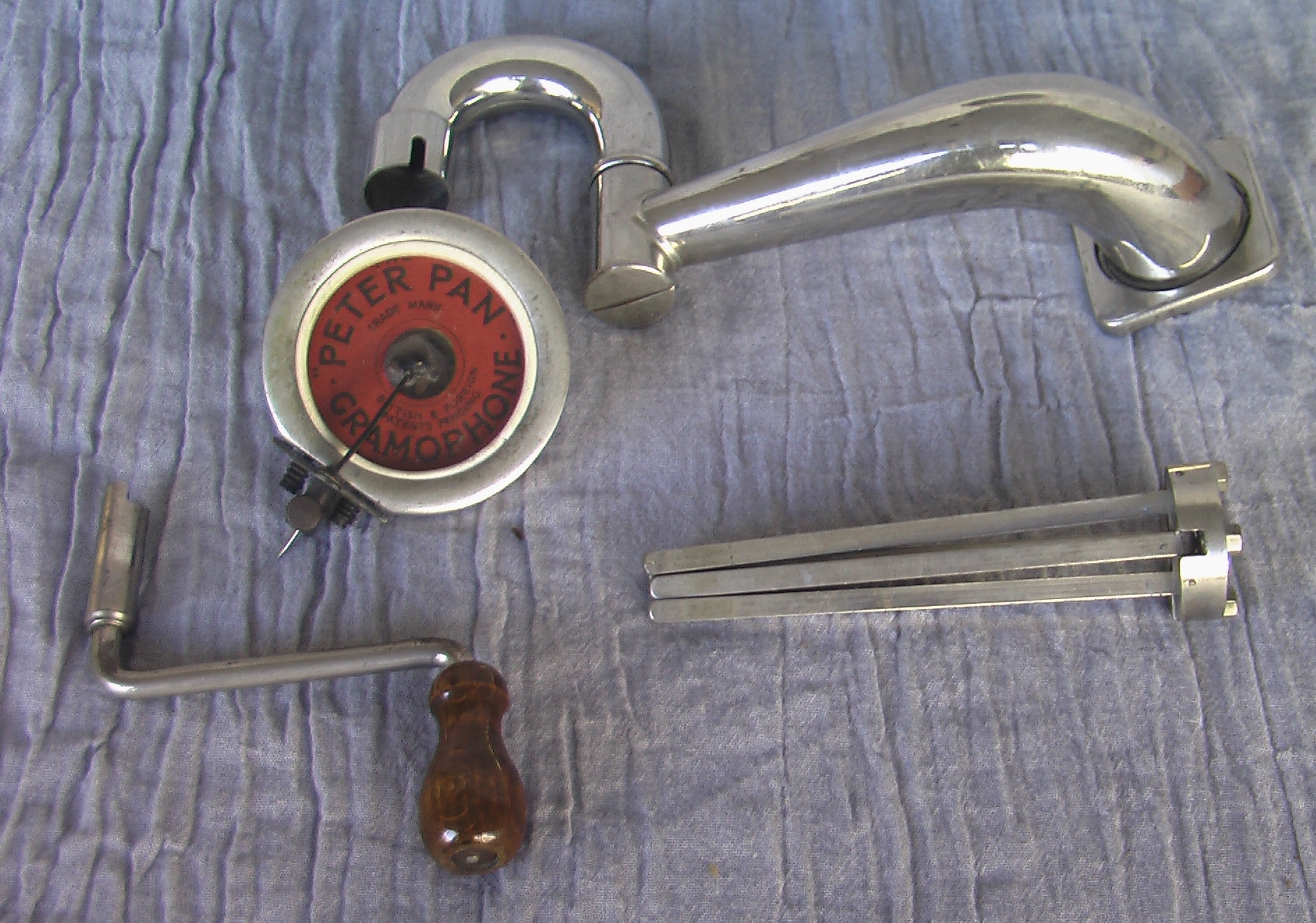
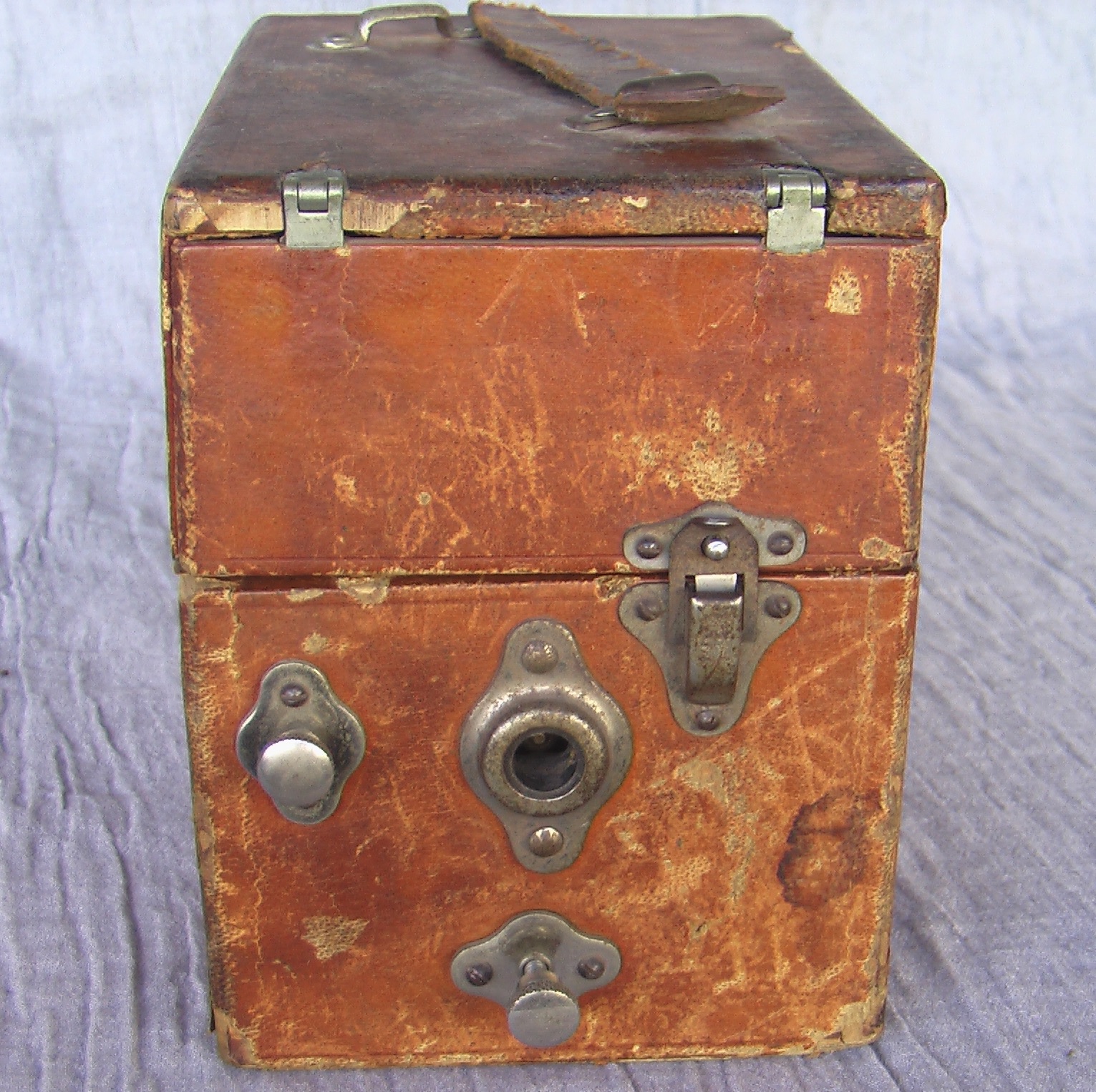
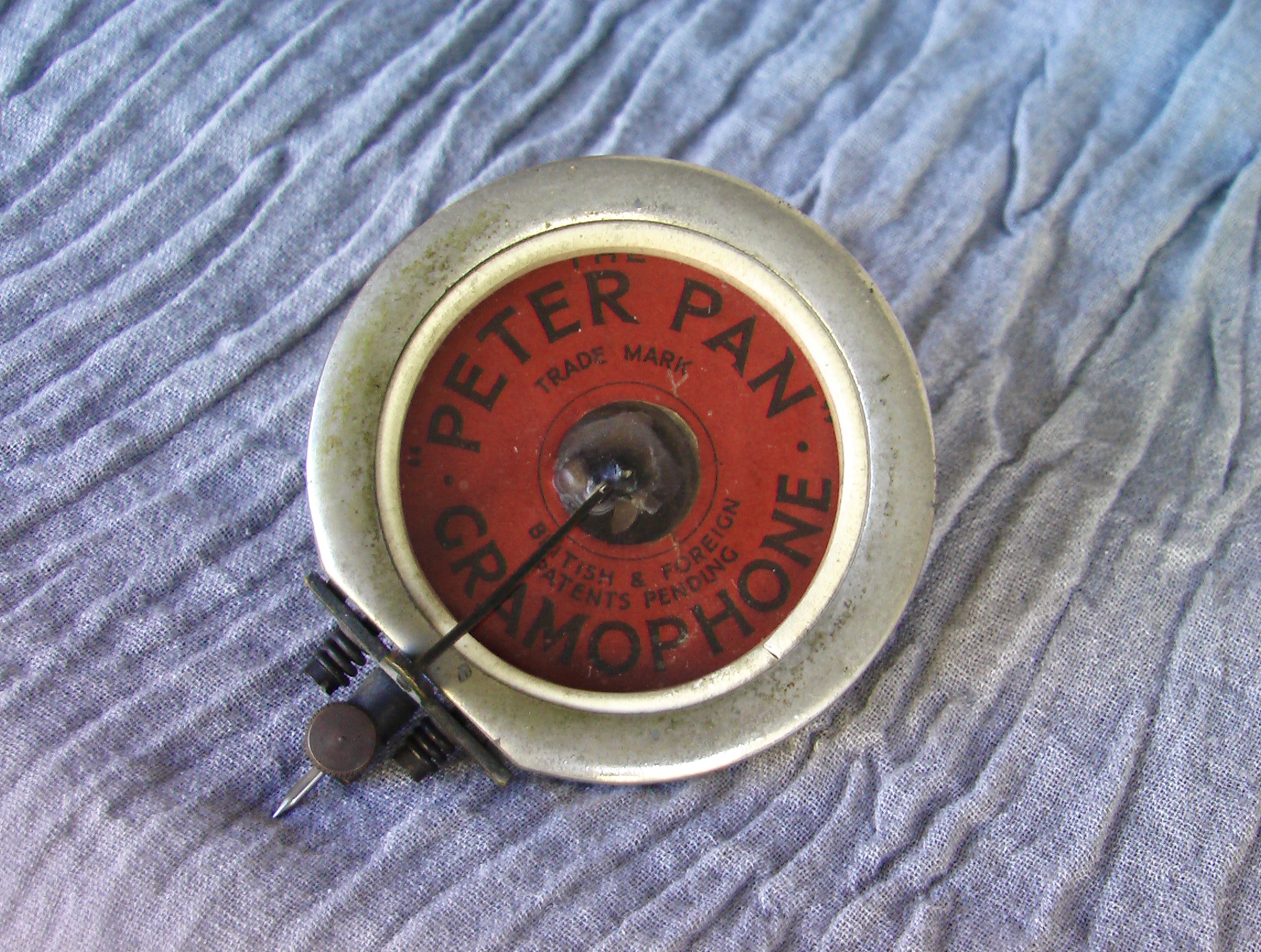
The Peter Pan Gramophone has all the same basic components of a larger cabinet phonograph of the time compactly enclosed into a leather-covered wooden box with a lid hinged at the top of one of its shorter side boards. Inside the box (and out of sight) is a Swiss manufactured clockwork motor made by Thorens. All the external components of the phonograph are detachable, miniaturized, and/or as collapsible as possible (see detail #1 for how they are stored in the case, and detail #2 for the detachable elements displayed outside the case): a soundbox/reproducer, a “goose-neck” tonearm, a turntable, a motor hand crank, and a collapsible speaker horn. When assembled (gallery #1), the phonograph’s 4-spoke “turntable” can handle a disc up to 12-inches in diameter; the machine can play only 78rpm lateral-cut disc records but the actual speed at which the turntable and disc rotates can be modified considerably by turning, in one direction or the other, a speed-control knob located in the upper-left corner of the case’s lower-front side (the other knob located on this side of the case is connected to another motor brake that basically serves as the phonograph’s on-off switch; the final feature on this face of the phonograph’s body is a hole that receives the motor’s hand crank) (detail #3).
Player - Instrument Interface and Sound Production
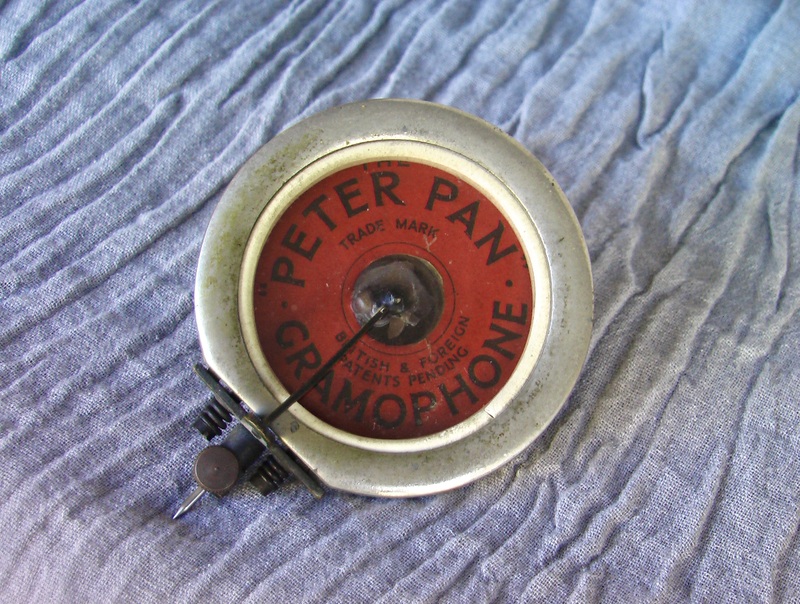
To play a 78rpm disc on the Peter Pan Gramophone the user must first place the machine on a flat surface and then open the lid by releasing the lid clip and fully opening the lid (detail #1). The phonograph’s soundbox/reproducer, tonearm, turntable, and motor hand crank can then be removed (detail #2). The phonograph’s speaker is prepared by dropping down the end wall of the lid and by sliding forward the top of the horn to fully unfold it (detail #4). The soundbox/reproducer can then be slid onto one end of the tone arm and the other end of the tone arm slid into the metal hardware on the top of the horn. If a sharp-pointed metal needle is not already attached to the reproduced, that can be done at this point (detail #5). The turntable is then slid over the exposed spindle of the machine’s motor and its four spokes dropped to their horizontal position (gallery #1). The non-handle end of the motor hand crank can then be inserted into the hole on the front-side of the machine and turned clockwise until met with resistance and then rotated as many times as necessary to fully wind up the motor spring. After placing a phonogram (a 78rpm disc) on the turntable, the motor brake can be released by turning the on/off switch knob counterclockwise, which sets the turntable and phonogram into rotation. The user than lowers the reproducer needle onto the phonogram; if the rate of rotation needs adjustment, this can be accomplished by turning the speed-control knob clockwise, to increase the rate of rotation, or counterclockwise, to slow the rate of rotation, while the phonogram is being played.
Origins/History/Evolution
While sound capture was first invented by Thomas Edison in 1878, Emile Berliner invented the disc-shaped phonogram and the disc phonograph in the early 1890s. By the end of the first decade of the 20th century, the disc phonograph (or gramophone, talking machine, disc graphophone—pseudonyms for “phonograph”) truly began to dominate the fast-evolving record industry and continued to do so until the advent of the digital compact disc (CD) in the 1980s. Purely mechanical, non-electric phonographs such as the Peter Pan started to give way to electrified phonographs and recording processes in the early 1920s. By the end of that decade, spring-motor phonographs and acoustical recording processes were totally eclipsed by electricity-powered phonographs with styluses that converted acoustical signals to electrical signals that were amplified by amplifiers and heard through loudspeakers, and the electrification of the recording studio and the mastering of recorded performances.
Bibliographic Citations
Bird, Callan, and Deeksha Bhardwaj. April, 2024. “Miniature gramophone leads procession of portable players,” Museum of Transport and Technology, Aukland, New Zealand, website accessed January 2, 2026: https://www.motat.nz/collections-and-stories/stories/miniature-gramophone-leads-procession-of-portable-players/
Fabrizio, Timothy C., and George F. Paul. 1997. The Talking Machine: an illustrated compendium, 1877-1929. Atglen, Pennsylvania: Schiffer Publishing Ltd.