Edison C-150 Diamond Disc phonograph
Also: Sheraton
Contextual Associations
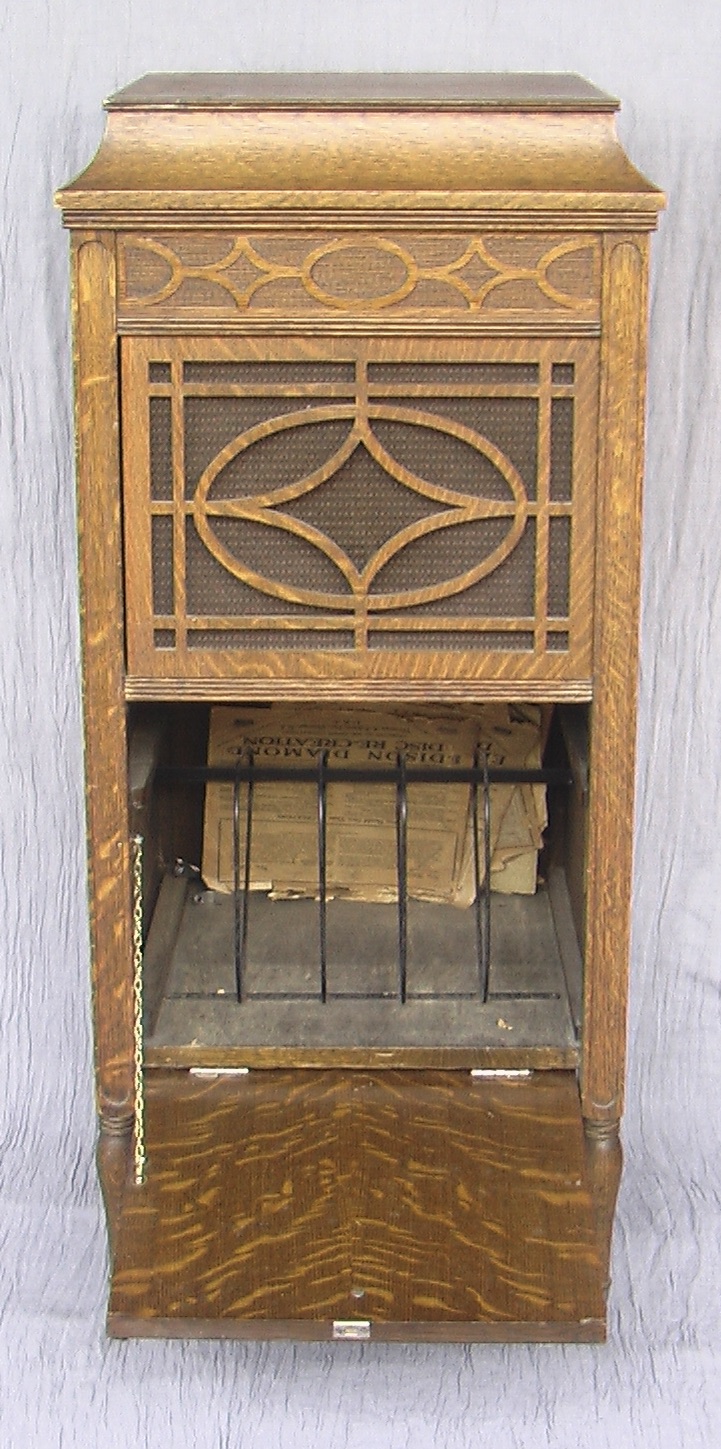
The Edison C-150 “Sheraton Design” disc phonograph is an internal horn mechanical stylusphone idiophone designed and manufactured in the U.S.A. between 1915 and 1918 and undoubtedly marketed also on the European continent and beyond. It differs from all the other disc phonographs in the Grinnell Collection in that it plays only vertical-cut disc phonograms (not lateral-cut ones) at a speed of 80rpm (not 78rpm). Edison designed and produced a specific phonogram to be played on his disc phonographs—Diamond Discs (the Grinnell Collection includes 43 of these phonograms)—and the diamond-tipped styluses on his disc phonographs could not play lateral-cut 78rpm discs that had become standard after years of being produced by his competitors—Victor, Columbia, and dozens of other companies. The C-150, also known as “the Sheraton”, cost $150 in 1915 and, by 1918, $175. It was considered a half cabinet upright model for home use (it was most definitely not portable) and was priced low to compete against similar low-end cabinet models produced by Edison competitors. This phonograph can be seen and heard in action in the above video.
Description
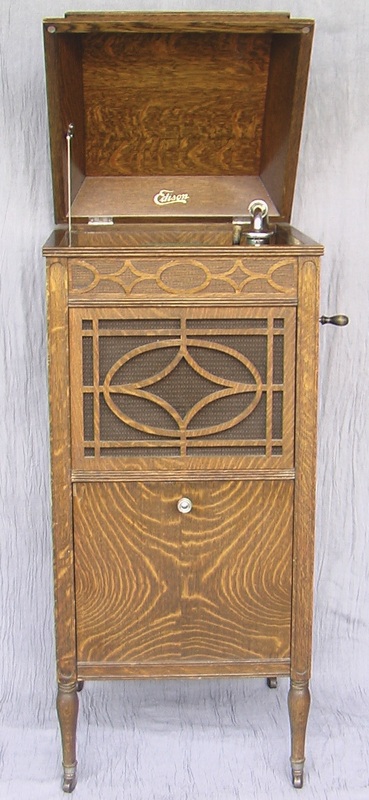
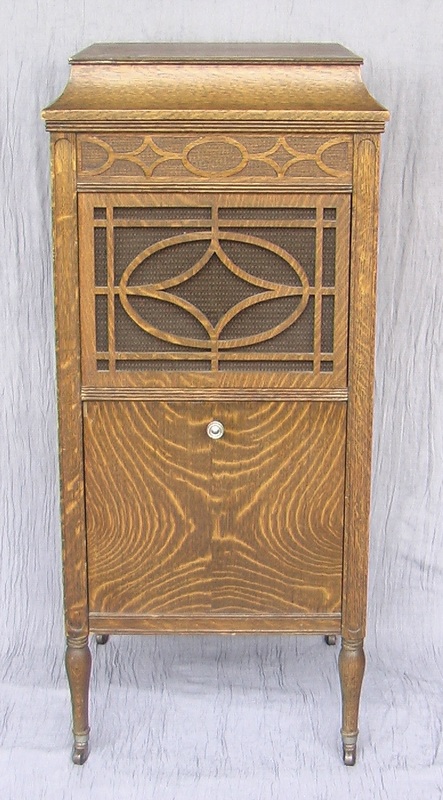
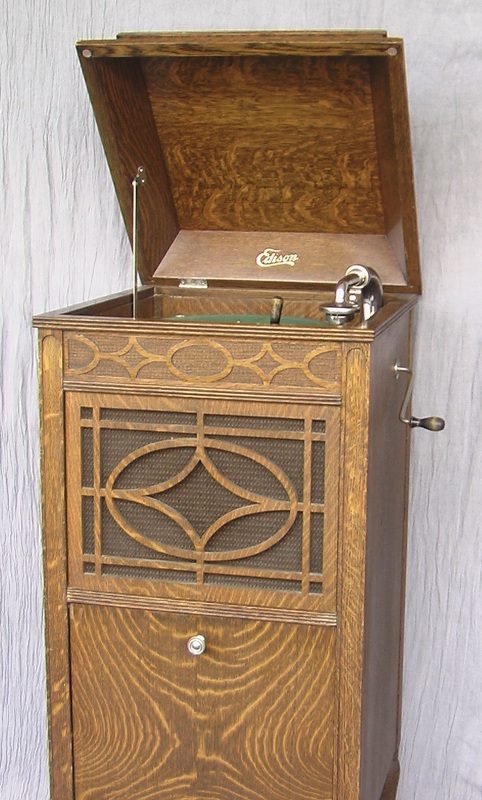
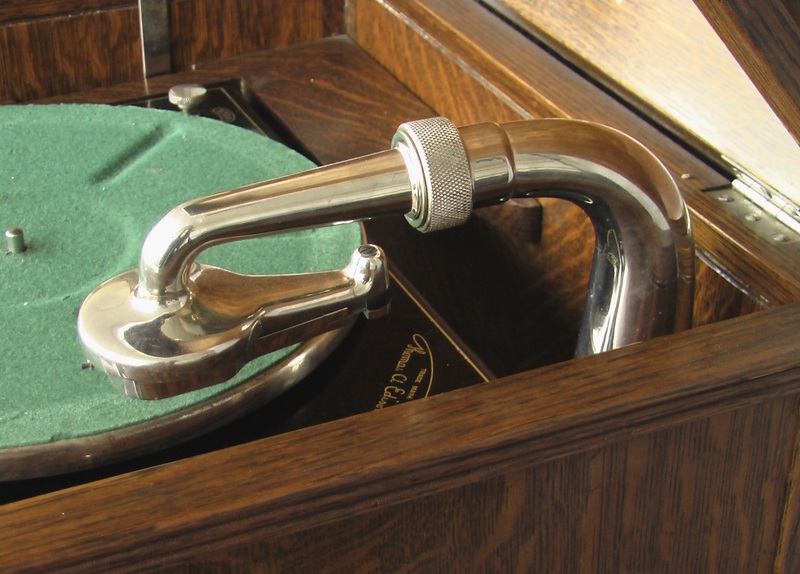
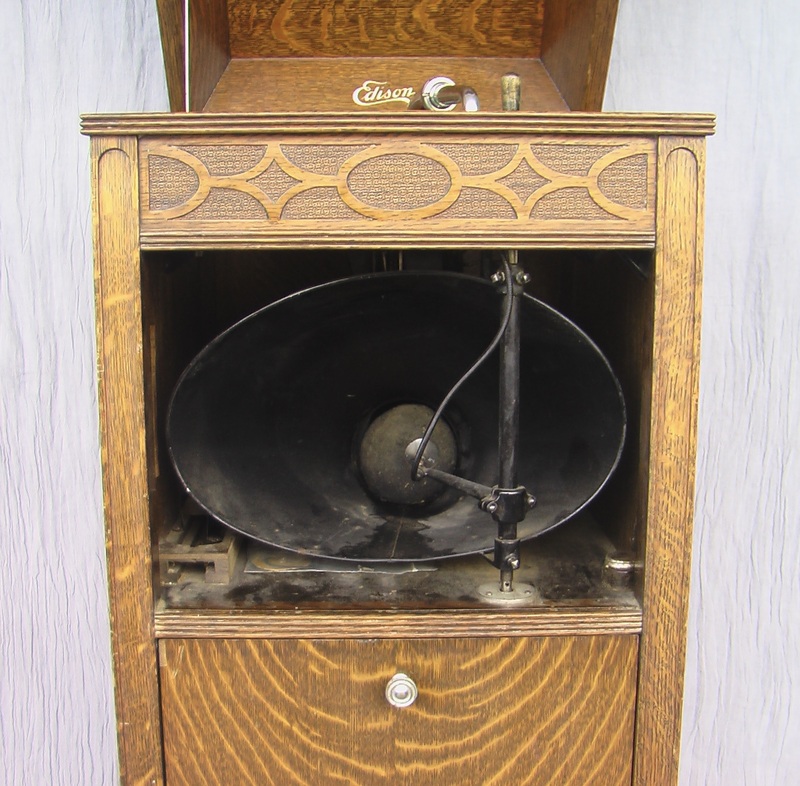
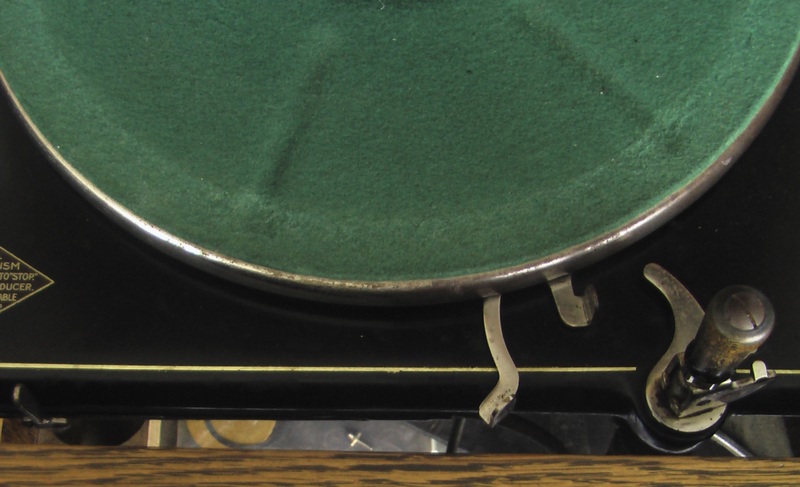
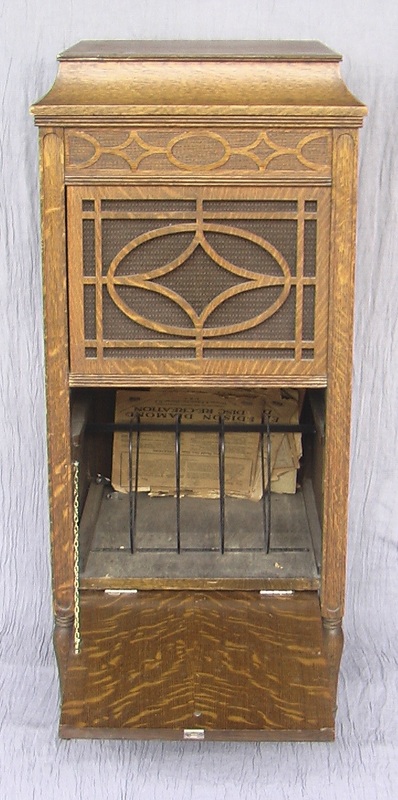
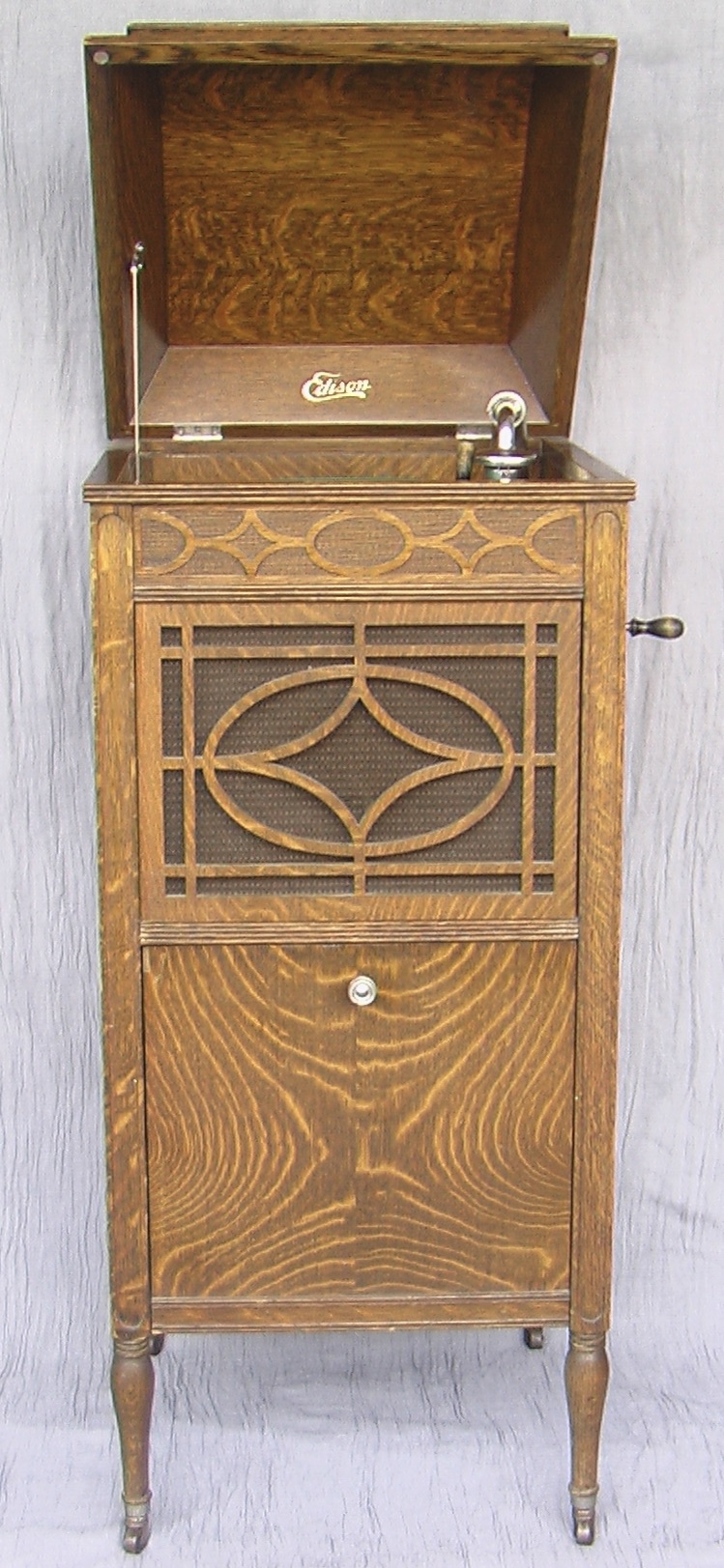
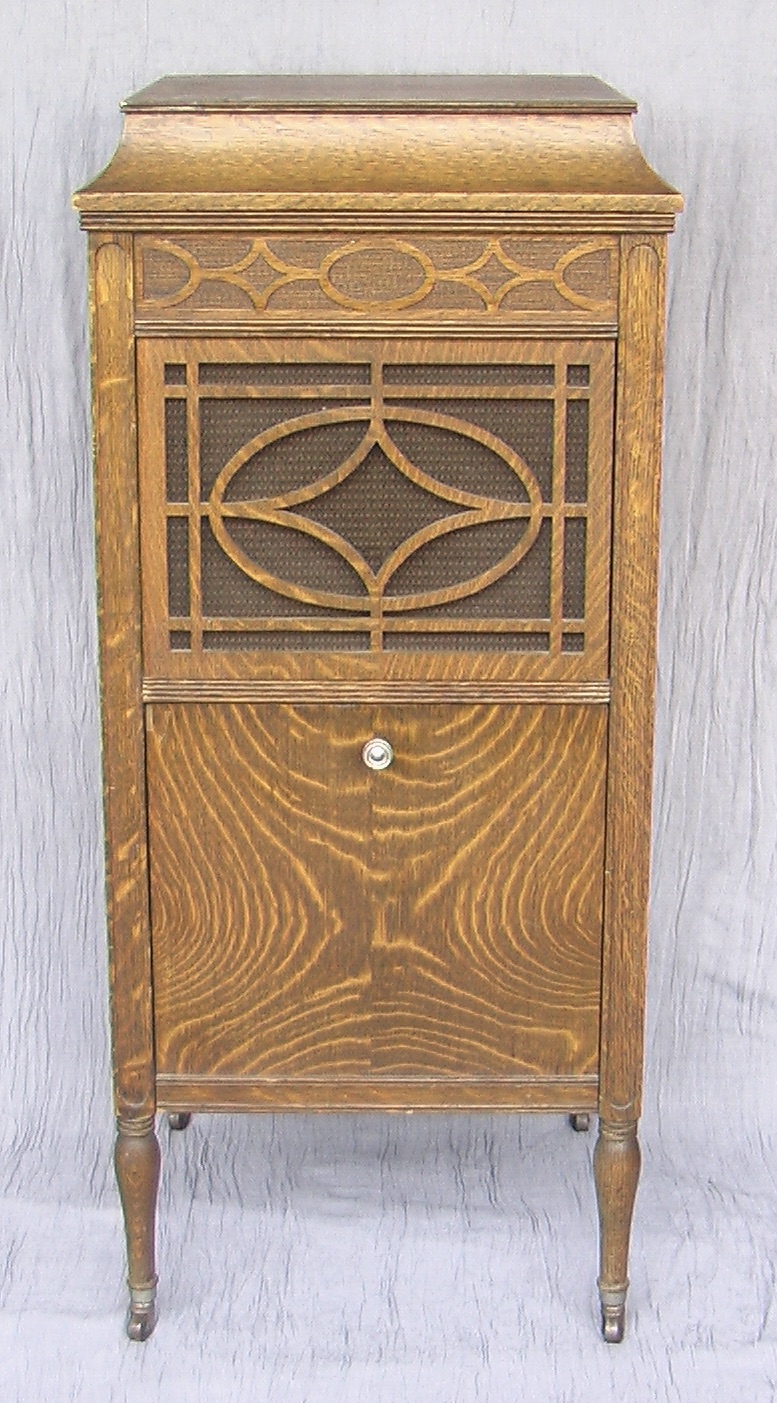
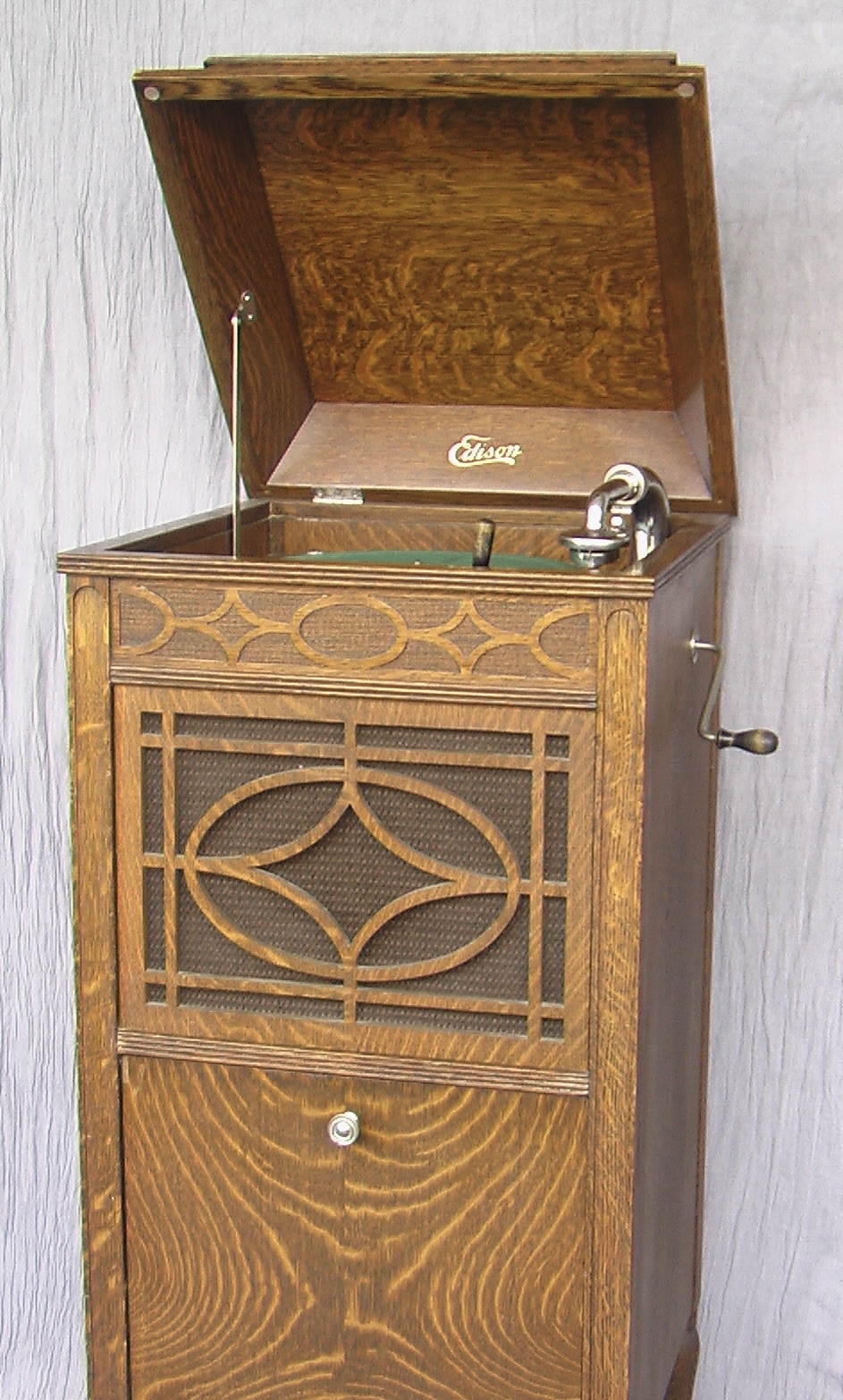
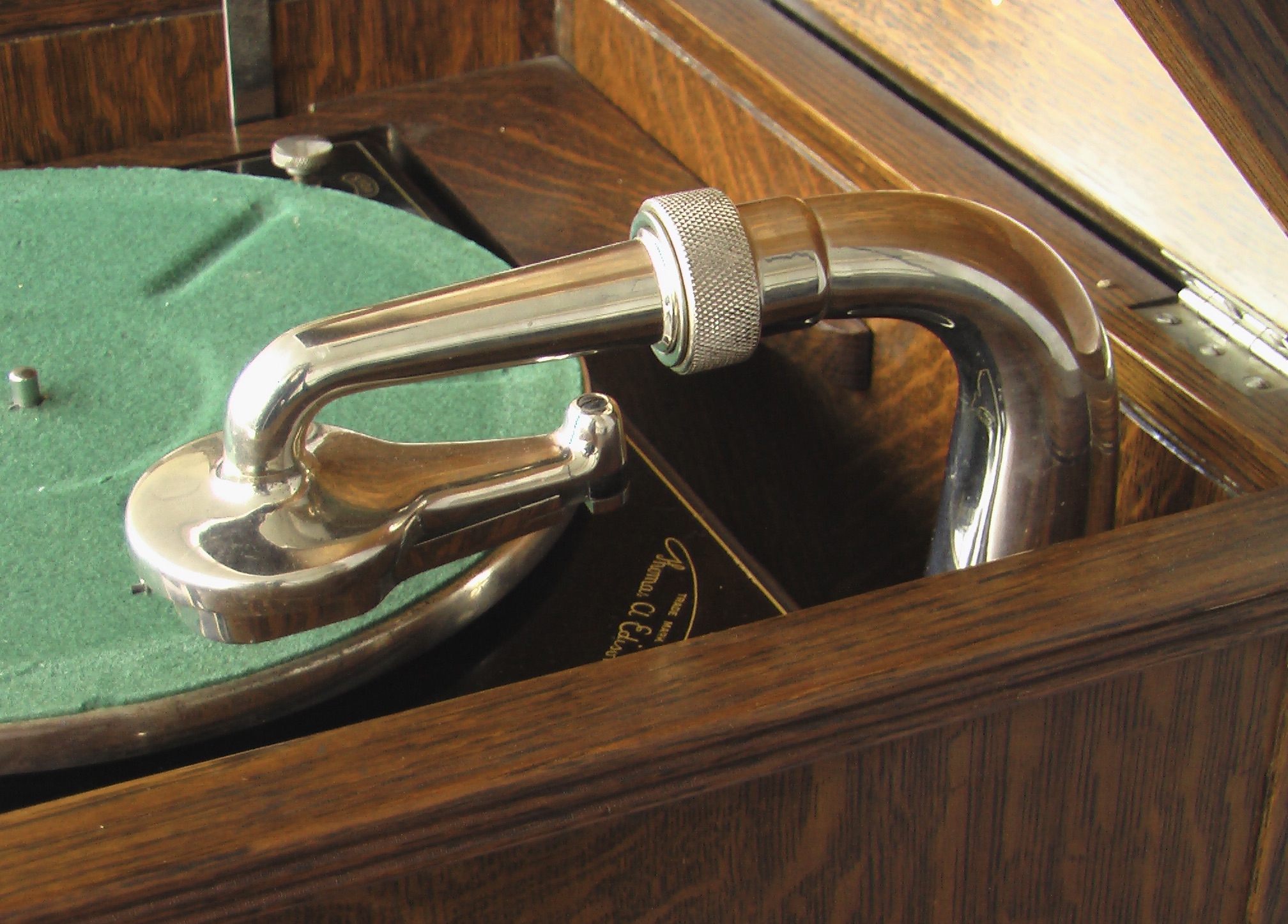
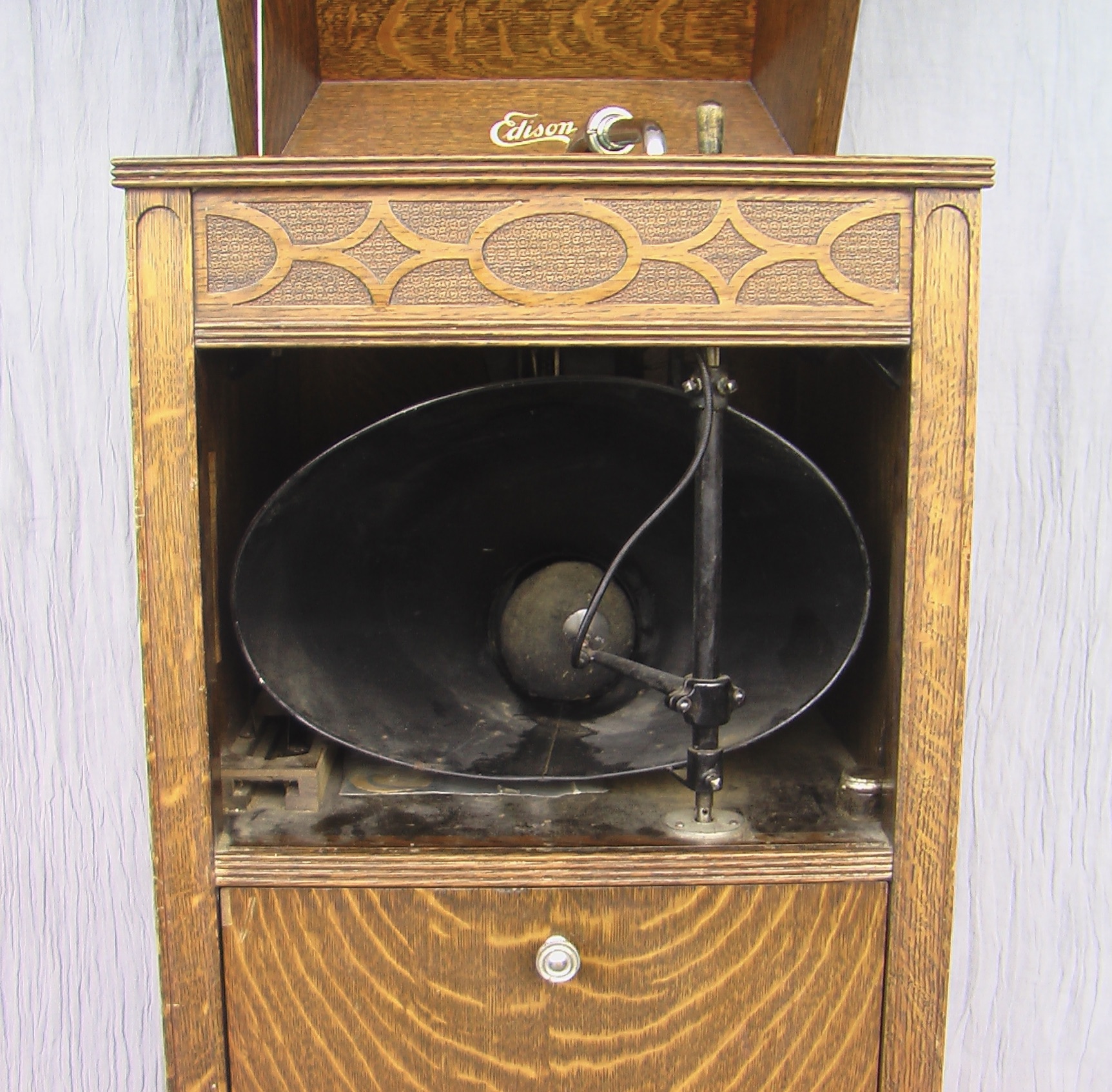
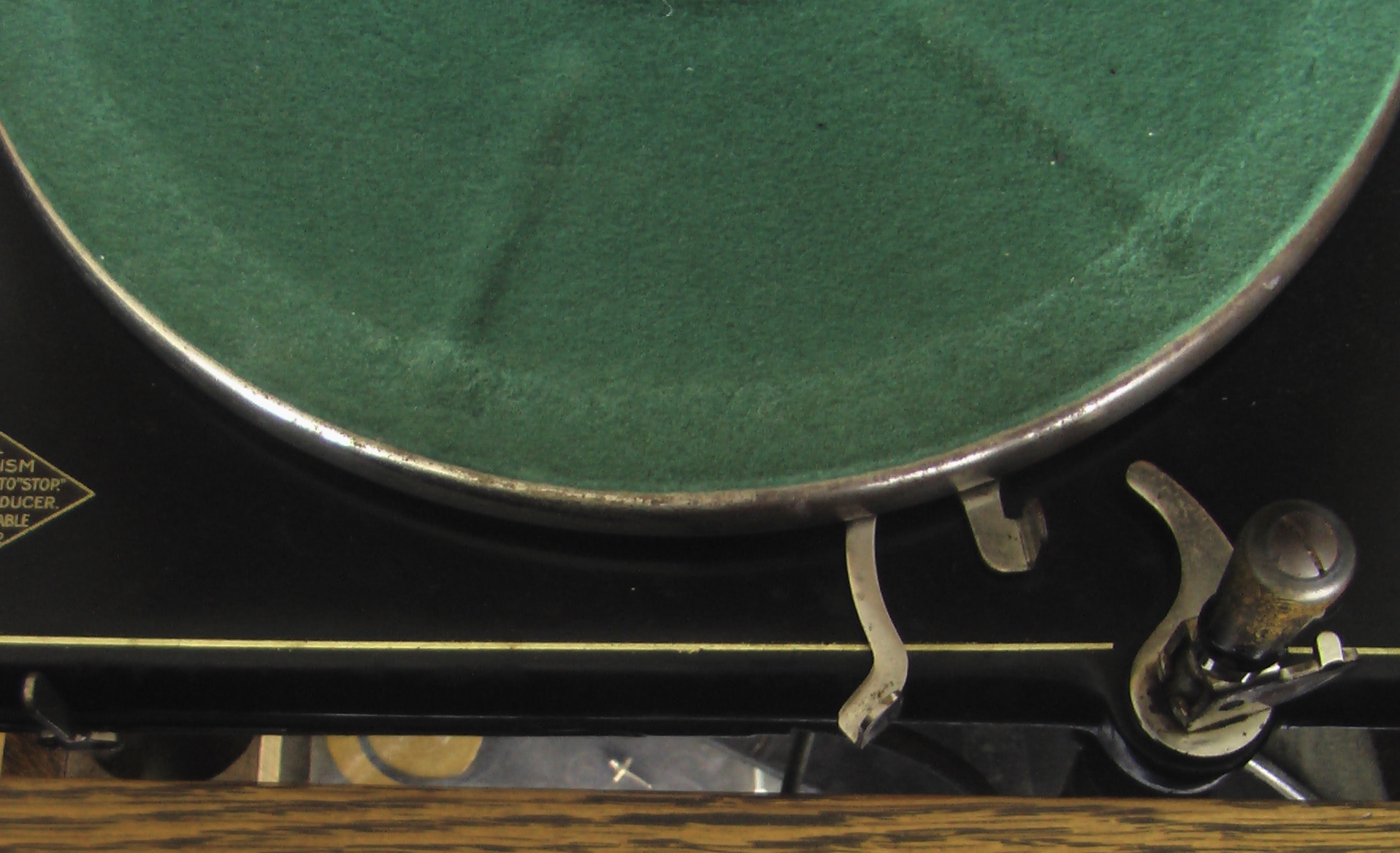
This Edison Sheraton seems to be in original condition and has possibly never been renovated in its approximately 110 years of existence. When not in use, the cabinet’s lid is closed (gallery #2); when in use the lid is opened (gallery #1). The mechanics of the machine (which are affixed to the bottom side of the phonograph’s top metal plate) are not easy to access, which is why there are no images or detailed description of its mechanics found on this page. The phonograph is powered by a single-spring motor the (removable) crank for which fits into a hole on a side panel of the wood cabinet (detail #1). The hollow tone arm is made of nickel-plated metal. At one end of the tone arm an Edison Model-C Diamond Reproducer is mounted; the other end of the tone arm turns sharply downwards and is secured to an end of a sheet-metal horn located out-of-sight beneath the top metal plate and behind the cabinet’s grill (detail #2). In detail #3, the grill has been removed to show the horn with its additional “ball tone modifier,” which is operated with a sliding level located near the turntable (barely visible in the lower-left corner of detail #4) and gives the operator of the phonograph some latitude in controlling the tone and volume of the sound emanating from the horn. When the cabinet’s lid is propped open, the phonograph’s felt-covered turntable, its tone arm and reproducer, and its various control levers (on-off switch; speed control knob; ball tone modifier slide, and the lever used to raise and lower the tone arm and reproducer) are all visible (detail images #2 and #4). A door on the front side of the cabinet and beneath the horn grill can be dropped down (it is hinged at its bottom to the cabinet) to expose a storage space for Diamond Disc records (detail #5).
Player - Instrument Interface and Sound Production
The player of the C-10 needs to make sure that, before playing a phonogram, the phonograph motor is completely wound. An 80rpmn 10-inch diameter Diamond Disc is then placed on the turntable so that the tip of the motor’s spindle protrudes through the hole at the middle of the disc. The user then releases the on-off brake by sliding its lever and, using the phonograph’s tone arm lever, gently places the diamond-tipped reproducer needle at the beginning of the phonogram’s groove spiral. If slight speed or tone adjustments are desired by the operator they can be affected with control slides and knobs on the top plate of the phonograph. We prefer to lower the lid once the playing of the phonogram has begun because it seems to mute some of the surface noise of the machine (this is not done in the accompanying video). When the recorded material encoded on the disc ends, the user must lift up the reproducer/tone arm with the appropriate lever and swing it back beyond the edge of the phonogram. The turntable brake lever can then be moved to its stop position and the phonogram can then be safely lifted off the turntable.
Origins/History/Evolution
While sound capture was first invented by Thomas Edison in 1878, Emile Berliner invented the disc-shaped phonogram and the disc phonograph in the early 1890s. By the end of the first decade of the 20th century, the disc phonograph (or gramophone, talking machine, disc graphophone—pseudonyms for the term “phonograph” the copyright for which was owned by Edison and used for his products) truly began to dominate the fast-evolving record industry and continued to do so until the advent of the digital compact disc (CD) in the 1980s. However, it was only around 1912 that Edison, who to this point had only produced cylinder machines, finally was convinced to move into the disc phonograph market (in addition to his new models of disc phonographs, Edison continued to design and market several cylinder phonograph models all the way until the end of his company’s existence in 1929). Purely mechanical, non-electric phonographs started to give way to electrified phonographs and recording processes in the early 1920s. By the end of that decade, spring-motor phonographs and acoustical recording processes were totally eclipsed by electricity-powered phonographs with styluses that converted acoustical signals to electrical signals that were amplified by amplifiers and heard through loudspeakers, and the electrification of the recording studio and the mastering of recorded performances.
Bibliographic Citations
Fabrizio, Timothy C., and George F. Paul. 1997. The Talking Machine: an illustrated compendium, 1877-1929. Atglen, Pennsylvania: Schiffer Publishing Ltd.
Frow, George L. 2001. The Edison Disc Phonographs and the Diamond Discs. 1st American ed., newly rev. and enlarged. Los Angeles: Mulholland Press. Inc.
Instrument Information
Origins
Continent: Americas
Region: North America
Nation: U.S.A.
Formation: Euro-American
Classification (Sachs-Von Hornbostel revised by MIMO)
112.521.2
Design and Playing Features
Category: idiophone
Energy input motion by performer: contours on the bottom of a phonogram groove
Basic form of sonorous object/s for idiophone: English
Sound objects per instrument: needle/stylus
Resonator design: one
Number of players: separate horn-shaped resonating space - built into instrument
Sounding principle: one
Sound exciting agent: flexing - indirect
Energy input motion by performer: contours on the bottom of a phonogram groove
Pitch of sound produced: none
Sound modification: definite pitch
Dimensions
19.5 in. width of cabinet
20.4 in, depth of cabinet
44.1 in. height of cabinet (lid closed)
57.0 in. height of cabinet (lid open)
2.5 in. diameter of soundbox
11.7 in. diameter of turntable
Primary Materials
metal
spring steel
wood
felt
Maker
Edison
Model
1915, Disc Phonograph C-150
Entry Author
Fabrizio, Timothy C., and George F. Paul. 1997. The Talking Machine: an illustrated compendium, 1877-1929. Atglen, Pennsylvania: Schiffer Publishing Ltd.
Frow, George L. 2001. The Edison Disc Phonographs and the Diamond Discs. 1st American ed., newly rev. and enlarged. Los Angeles: Mulholland Press. Inc.